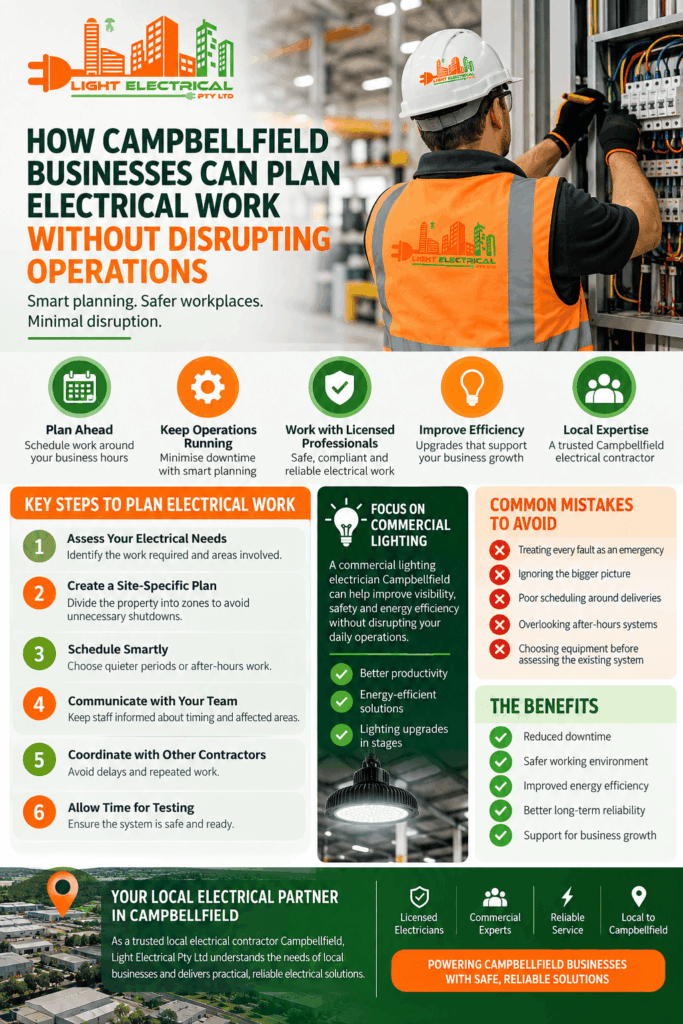
Electrical work in a busy commercial property is rarely as simple as switching off the power and starting the job. In Campbellfield, businesses may have workshops, warehouses, retail areas, offices, machinery, refrigeration, security systems and loading operations running throughout the day. Even a short interruption can affect staff productivity, customer service, deliveries and production schedules.
That is why Planning Commercial Electrical Work in Campbellfield should begin well before an electrician arrives on site. The goal is not simply to complete the electrical work safely. It is to organise the project around the way the business operates.
Whether you are arranging an installation, electrical upgrade, repair or maintenance program, working with a qualified commercial electrician Campbellfield can help you identify operational risks early and plan the work around them.
This guide explains how businesses can prepare for commercial electrical work, reduce unnecessary downtime and make better decisions about scheduling, access, safety and ongoing maintenance.
Why Commercial Electrical Work Requires Careful Planning
Commercial properties are often more complicated than residential buildings. A business may have several electrical circuits serving different areas and equipment. Some systems may need to remain operational while other sections are isolated.
For example, a Campbellfield warehouse might have:
High-bay lighting across storage areas
Forklift charging equipment
Office power circuits
Security and access-control systems
Emergency lighting
CCTV and communications equipment
Automated doors
HVAC systems
Machinery and production equipment
A shutdown affecting the wrong circuit could stop an important business process.
An experienced Commercial Electrician therefore needs to understand more than the immediate electrical fault or installation requirement. The electrician should consider what the circuit supplies, when the area is occupied, what equipment is connected and whether the work can be isolated in stages.
Good planning also helps prevent rushed decisions. If a business waits until an electrical problem becomes an emergency, there may be fewer options for scheduling the repair around operations.
Planning Commercial Electrical Work in Campbellfield
The first step is to define exactly what needs to be done.
A business owner or facilities manager may know that lights are unreliable or that the switchboard needs attention, but that does not necessarily describe the complete electrical requirement. An inspection can reveal related issues that should be addressed during the same visit.
For example, repeated lighting failures could result from faulty fittings, unsuitable lamps, damaged wiring, circuit issues or an underlying power problem. Replacing individual lights without identifying the cause may lead to repeated disruption.
Before work begins, discuss:
The purpose of the electrical project
Areas that require access
Equipment that must remain operational
Preferred working hours
Required shutdowns
Known electrical faults
Previous electrical work
Access restrictions
Workplace safety procedures
Any deadlines or business-critical dates
This information gives the electrician a clearer picture of the working environment.
Create a Site-Specific Work Plan
A useful work plan should divide the property into practical areas rather than treating the entire building as one electrical system.
For example:
Zone 1: Front office and reception Zone 2: Warehouse lighting Zone 3: Workshop machinery Zone 4: Staff facilities Zone 5: External areas and loading zones
If only Zone 2 needs electrical work, there may be no reason to shut down the whole premises.
This approach is particularly useful for larger commercial properties where different circuits can potentially be isolated independently.
Schedule Work Around Business Activity
Timing is one of the simplest ways to reduce disruption.
A business operating from 8 am to 5 pm may have completely different electrical requirements outside those hours. A warehouse may have quiet periods during the afternoon, while a retail operation may be busiest during weekends.
Before scheduling work, consider your actual operational pattern rather than simply choosing the earliest available appointment.
Ask:
When are customer-facing areas least busy?
When is machinery normally switched off?
When do deliveries arrive?
Are there production deadlines?
Which employees need uninterrupted access?
Is the building occupied overnight?
Are security or access systems required after hours?
For some businesses, electrical work can be divided into several smaller stages. Instead of shutting down an entire site for one long period, individual circuits or areas may be worked on separately.
That does not mean every project can be completed without interruption. Some work requires a complete isolation for safety. The important point is to identify those requirements in advance.
Commercial Electrician Planning for Power Isolation
Power isolation is one of the most important considerations in commercial electrical work.
A business should never assume that a particular piece of equipment can simply be switched off locally. Electrical isolation may need to occur at the relevant circuit or switchboard, depending on the work involved.
A qualified commercial electrician Campbellfield can determine the appropriate isolation procedure and identify which systems will be affected.
For example, replacing a distribution board may affect multiple circuits at once. In contrast, installing additional lighting in one warehouse section may allow other parts of the property to remain operational, depending on the existing installation and the work required.
Businesses should also communicate planned outages to staff.
A simple internal notice can explain:
Date of electrical work
Expected interruption period
Areas affected
Equipment that must be switched off
Alternative access arrangements
When normal operations are expected to resume
Clear communication prevents staff from unknowingly restarting equipment while electrical work is underway.
Electrical Services That Can Be Planned in Stages
Not every commercial electrical project needs to happen at once.
Depending on the condition of the installation and the scope of work, businesses may be able to divide projects into manageable stages.
Electrical Maintenance
Preventive Electrical Maintenance can often be scheduled during quieter periods rather than waiting for equipment or circuits to fail during normal operations.
A maintenance program may include inspection of electrical equipment, identification of deteriorated components, testing where appropriate and checking areas that have experienced recurring faults.
The exact maintenance requirements depend on the property, equipment and electrical installation.
For example, a workshop with heavy machinery may have very different maintenance considerations from a small professional office.
Electrical Repairs
Electrical Repairs should be prioritised according to risk and operational importance.
A flickering light in a non-critical storage room is different from an electrical fault affecting a refrigeration system, production line or safety system.
However, businesses should not assume that a minor-looking electrical issue is automatically safe to leave unattended.
Signs that warrant professional assessment can include:
Repeated circuit breaker trips
Burning smells near electrical equipment
Buzzing or crackling sounds
Damaged switches or outlets
Heat around electrical components
Flickering or repeatedly failing lights
Unexpected power interruptions
Visible cable damage
Electrical faults can have safety implications as well as operational consequences.
Plan Commercial Lighting Separately
Lighting deserves particular attention because it affects both visibility and day-to-day working conditions.
A warehouse, workshop, showroom and office may require different lighting arrangements. Simply installing brighter fittings is not necessarily the correct solution.
A commercial lighting electrician Campbellfield can assess how lighting is being used and consider factors such as fitting position, task requirements, glare, coverage, switching arrangements and energy consumption.
For example, a warehouse may have adequate lighting near storage aisles but poor illumination around loading or packing areas. A lighting upgrade can therefore be planned around the actual work being performed rather than treating every area identically.
Commercial lighting projects can also be staged.
A business might first address areas with poor visibility, then upgrade secondary areas later. Where suitable, controls such as occupancy or daylight-responsive systems may also be considered.
The key is to assess the existing installation before choosing replacement fittings.
Coordinate Electrical Work With Other Contractors
Commercial properties frequently have several contractors working on the same building.
Electrical work may overlap with:
Building renovations
Air-conditioning installation
Security upgrades
Data cabling
Machinery installation
Shopfitting
Ceiling work
Fire and safety-related works
Poor coordination can create unnecessary delays.
Imagine a business replacing its ceiling after an electrical contractor has completed new lighting. If the ceiling contractor later needs to remove sections or move fittings, electrical work may have to be repeated.
The better approach is to establish the order of work before contractors begin.
Ask each contractor:
What access do you need?
What areas will be unavailable?
What other trades need to finish first?
What services need to be isolated?
What work could affect another contractor?
What needs to be tested before the next stage?
This is especially important during larger fit-outs and renovations.
Work With a Licensed Electrician Campbellfield VIC
Commercial electrical work should be undertaken by appropriately licensed electrical professionals.
A licensed electrician Campbellfield VIC can assess the electrical installation, identify faults and undertake electrical work within the scope permitted by their licence and applicable requirements.
Businesses should also avoid making assumptions based solely on an electrician’s quoted price. Ask what the quotation includes and whether it covers inspection, testing, materials, access requirements and any necessary follow-up work.
A transparent quotation should make it easier to understand what is being proposed.
For more complex projects, it can also be useful to ask whether additional electrical capacity, switchboard considerations or circuit changes may be required before new equipment is installed.
This is particularly relevant when a business is adding machinery or significantly increasing its electrical load.
How a Local Electrical Contractor Campbellfield Can Reduce Disruption
Working with a local electrical contractor Campbellfield can make site coordination more practical, particularly when the project involves multiple visits.
A contractor who understands commercial working environments can help identify logistical considerations before work starts.
For example, the project may require:
Early access to the premises
Coordination with site management
Access to a plant room or switchboard
Temporary barriers
Isolation of specific circuits
Safe access equipment
Work outside normal trading hours
Testing before the site returns to normal operation
The benefit of planning is not simply convenience. It allows the business and electrical contractor to agree on responsibilities before the work begins.
A Practical Pre-Work Checklist for Campbellfield Businesses
Before the electrician arrives, prepare the following information where available.
1. Identify the affected areas
Mark the rooms, warehouse sections, machinery areas or external zones involved.
2. Identify critical equipment
List equipment that cannot be unexpectedly switched off, such as servers, refrigeration, production machinery or security systems.
3. Confirm access
Make sure the electrician can safely reach switchboards, equipment, ceiling spaces and other relevant areas.
4. Review operating hours
Explain your normal business schedule and identify periods when disruption would have the greatest impact.
5. Notify employees
Tell staff what areas may be affected and when electrical work is expected to occur.
6. Coordinate other contractors
Confirm whether builders, technicians, installers or other trades are working at the property.
7. Allow time for testing
Do not schedule the electrical shutdown so tightly that there is no time for appropriate testing before operations resume.
8. Keep records
Retain relevant documentation about completed electrical work, equipment changes and identified issues. These records can be useful when planning future upgrades or maintenance.
Common Mistakes Businesses Make
Even well-organised businesses can overlook important details when arranging electrical work.
Treating Every Electrical Problem as an Emergency
Some faults require immediate attention. Others can be assessed and scheduled appropriately.
Trying to classify everything as an emergency can make planning more difficult. The priority should be based on safety, the nature of the fault and its impact on critical operations.
Focusing Only on the Immediate Repair
If a circuit repeatedly trips, simply resetting the breaker or replacing a component may not address the underlying issue.
The electrician should investigate why the fault is occurring rather than treating repeated symptoms as isolated events.
Scheduling Work Without Considering Deliveries
A warehouse may appear quiet at certain times but still have scheduled loading activities.
Electrical work that blocks access routes or affects loading-area lighting can create operational problems even if the building itself is not busy.
Forgetting About After-Hours Systems
Security systems, access controls, refrigeration and other equipment may continue operating outside normal business hours.
These systems should be considered when planning shutdowns.
Choosing Equipment Before Assessing the Existing System
Businesses sometimes select new electrical equipment first and ask whether the existing installation can support it later.
The sequence should generally be reversed. Assess the electrical capacity and installation requirements before finalising equipment that could significantly increase electrical demand.
Expert Tips for Reducing Downtime
A few practical decisions can make a noticeable difference.
Group related work together. If several tasks require access to the same area, completing them during one planned visit may reduce repeated disruption.
Photograph relevant areas beforehand. Photos can help document existing equipment and assist with planning, although they do not replace an electrical inspection.
Build contingency time into the schedule. Unexpected conditions can be discovered once electrical equipment is opened or tested. A schedule with no flexibility can create pressure and rushed decisions.
Ask about testing and commissioning. Do not treat physical installation as the end of the project. Electrical systems and equipment may need appropriate testing before normal operation resumes.
Review recurring faults. If the same circuit, light or equipment repeatedly causes problems, record the dates and symptoms. This information can help the electrician identify patterns.
Plan before business growth creates pressure. Adding machinery, refrigeration, workstations or lighting can change electrical requirements. Electrical planning should form part of larger expansion plans.
Conclusion
Electrical work does not have to bring a Campbellfield business to a complete standstill. The difference often comes down to preparation.
Start by identifying what needs to be done, understand which parts of the business depend on the affected electrical systems and schedule the work around genuine operational requirements. Consider isolation, access, employee communication, other contractors and testing before the project begins.
For lighting projects in particular, a commercial lighting electrician Campbellfield can help assess how lighting supports the way each area is actually used, rather than treating every commercial space the same.
Most importantly, electrical planning should be part of normal business management rather than something considered only after a failure occurs. Working with a qualified commercial electrician Campbellfield and maintaining clear records can help businesses approach repairs, upgrades and future expansion with fewer surprises and better operational control.
Frequently Asked Questions
How far in advance should a Campbellfield business schedule electrical work?
For planned upgrades and maintenance, scheduling several days or weeks ahead gives the business more opportunity to coordinate staff, contractors and operating requirements. Larger projects may require considerably more planning.
The right timeframe depends on the scope of work. A straightforward repair may be arranged relatively quickly, while switchboard upgrades, major lighting projects or fit-outs require detailed coordination.
Can commercial electrical work be completed outside normal business hours?
In some circumstances, yes. Businesses can discuss after-hours work with their electrician when daytime disruption would significantly affect operations.
However, availability, site conditions, access, safety requirements and the nature of the electrical work all need to be considered. Some tasks may still require a planned shutdown regardless of the time of day.
How can a business keep operating during electrical work?
The answer depends on the electrical distribution within the property. Where practical, work may be staged so unaffected areas continue operating.
An electrician can identify the circuits and systems affected by the proposed work. Businesses should never create their own temporary electrical arrangements without appropriate professional advice.
Should electrical maintenance be scheduled even when nothing appears wrong?
Preventive maintenance can help identify deterioration or developing issues before they result in an unexpected failure.
The appropriate maintenance frequency depends on the electrical installation, equipment, operating environment and applicable requirements. A commercial electrician can help determine what inspection and maintenance approach is appropriate for the particular premises.
When should a business contact a commercial electrician?
Businesses should arrange professional assessment when they notice recurring electrical faults, damaged electrical equipment, unexplained power interruptions, burning smells, unusual sounds, repeated circuit trips or other concerning electrical behaviour. For planned work, contacting an electrician early is useful because the project can be assessed before it becomes an operational emergency.
At Light Electricians Pty Ltd., we care about our clients and helping them get peace of mind knowing that your electricians system is working properly. Our technicians are licensed, trained, and skilled to handle any electricians project, no matter how big or small. Our electricians design, install, service, and repair electricians systems and parts in strict accordance with the highest industry standards. Our team knows you’re busy, and your time is valuable.
Contact Light Electricians Pty Ltd. today to get a competitive quote for the best brand of safety switches and switchboard upgrades, whether you want to do a major upgrade or need to replace all your circuit breakers with safety switches. We are committed to absolute professionalism and take great pride in our customers' satisfaction. Don't wait to get your switchboard upgraded contact us today.