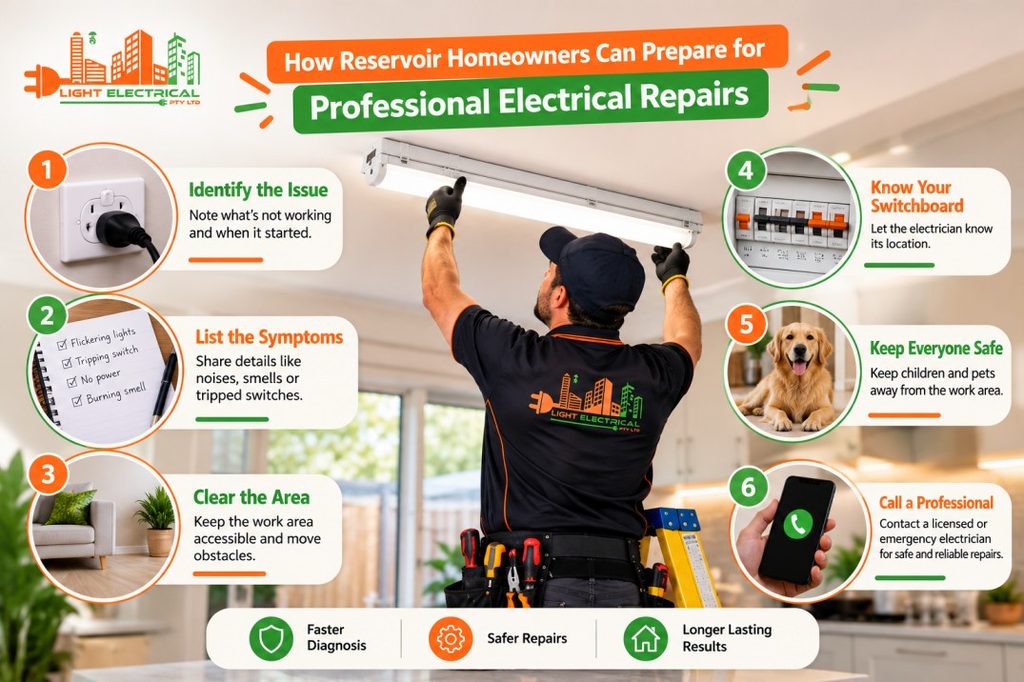
Electrical issues rarely happen at a convenient time. A power point may stop working before dinner, lights may begin flickering during the evening, or a safety switch may repeatedly trip whenever an appliance is turned on. These situations can disrupt daily routines and raise important questions about the safety of your home.
For homeowners looking for electrical repairs in Reservoir, knowing what to do before an electrician arrives can make the repair process safer, clearer, and more efficient. Preparation helps you explain the symptoms accurately, provide access to the affected areas and understand what the electrician needs to investigate.
The priority is always safety. Electrical faults should never be ignored or treated as simple DIY projects. According to Energy Safe Victoria, electrical work must be carried out by an appropriately licensed professional, as unqualified electrical work can cause serious injury, fire or electric shock.
Whether you live in an established Reservoir property, a renovated family home or a newer residence, this guide explains how to prepare for electrical repairs, recognise warning signs and make informed decisions when arranging professional assistance.
Why Preparing for Electrical Repairs in Reservoir Matters
Preparing for an electrical repair appointment is about more than clearing space around a power point. It helps establish what has happened, when the problem started and whether there are signs of a wider electrical fault.
Reservoir homes can vary considerably in age, layout, renovations and electrical equipment. Some properties may have older fittings, while others have additional appliances, air conditioning, home office equipment or upgraded lighting. The actual condition of the wiring and switchboard must be assessed individually rather than assumed from the property’s age.
Good preparation can help with three important aspects of a repair.
Clearer diagnosis: Specific information about the fault gives the electrician a useful starting point.
Safer access: Keeping people away from damaged fittings and clearing the work area reduces avoidable risks.
Better planning: Knowing which appliances, rooms or circuits are affected helps the electrician assess the likely scope of work.
For example, imagine that the kitchen power points stop working whenever the kettle is used. Telling the electrician whether the problem affects one outlet, several outlets or the entire kitchen is more useful than simply reporting that the electricity is faulty.
The electrician still needs to test the installation and determine the cause. However, accurate observations can help narrow down the investigation.
1. Recognise Common Electrical Problems Before Booking
Understanding the symptoms is one of the most practical steps you can take before arranging electrical repairs in Reservoir. You do not need to diagnose the fault yourself. Your task is to recognise what is happening and communicate it accurately.
What are the common electrical problems homeowners should watch for?
Some warning signs are relatively obvious, while others develop gradually.
Flickering or dimming lights: A light may flicker because of a faulty lamp, a poor connection, or another electrical issue. If several lights flicker together, the problem deserves prompt professional attention.
Repeatedly tripping safety switches: A safety switch may disconnect power when it detects an electrical leakage problem. Repeated tripping can indicate a faulty appliance, damaged wiring, or another issue that needs investigation.
Non-working power points: A power point that stops working may have a local fault or may be connected to a circuit that has lost power. Do not remove the cover or attempt to inspect its wiring.
Buzzing or crackling sounds: Unusual noises from a switchboard, switch or power point should not be ignored. Stop using the affected fitting and seek professional advice.
Burning smells or scorch marks: A burning-plastic smell, discolouration or visible melting near an electrical fitting can indicate overheating. Treat this as an urgent safety concern.
Warm switches or outlets: Unusual heat around a fitting may suggest an electrical fault, especially when accompanied by a burning smell, noise or visible damage.
When should you stop using an electrical fitting?
Stop using the affected fitting if you notice unusual heat, buzzing, sparks, damage or a burning smell. Do not touch exposed wires or damaged equipment.
If there is smoke, an active fire or immediate danger, move away, keep others clear and call Triple Zero (000) if emergency services are required. Do not approach a damaged switchboard or attempt to extinguish an electrical fire using water.
Recognising these signs early helps you explain the urgency when contacting an electrician.
2. Prepare Accurate Information for Fault Finding
Effective Fault Finding begins with understanding the symptoms, but the cause must be established through appropriate testing. Homeowners can support this process by recording observations rather than experimenting with electrical equipment.
What information should you give the electrician?
Before the appointment, write down the answers to these questions:
Which room or area is affected?
What stopped working, such as lights, power points or a particular appliance?
When did the issue first appear?
Does it happen continuously or only occasionally?
Did it begin after a storm, renovation, appliance installation or other noticeable event?
Has the safety switch or circuit breaker tripped?
Have you noticed unusual smells, noises, heat or visible damage?
Do not deliberately recreate a fault to answer these questions. If an appliance causes the power to trip, leave it disconnected if it is safe to do so and tell the electrician what happened.
You can also take photographs of visible damage from a safe distance, provided doing so does not bring you near a hazardous area.
How does this information help with diagnosis?
Consider a homeowner who reports that the lights in one room occasionally flicker. If the homeowner can explain that the issue occurs when a particular appliance operates, the electrician has an additional observation to consider.
That observation does not prove the appliance is responsible. It simply provides a useful lead for testing.
Similarly, if the power fails throughout the property, the electrician may need to establish whether the issue lies within the home’s installation or relates to the external electricity supply. Not every outage originates inside the house.
Clear reporting helps the professional distinguish between possible causes without relying on guesswork.
3. Choose a Licensed Electrician in Reservoir VIC
Choosing the right professional is one of the most important decisions when arranging electrical work.
When searching for a licensed electrician in Reservoir, VIC, check that the person undertaking the work holds the appropriate Victorian electrical licence or registration for the task. Energy Safe Victoria provides information about checking electrical qualifications and finding appropriately licensed workers.
Do not assume that someone is qualified simply because they advertise maintenance, handyman or general property repair services.
What should you check before confirming an appointment?
Ask the electrician or business:
Are you appropriately licensed for the electrical work required?
Do you service Reservoir and the surrounding northern suburbs of Melbourne?
Is there a call-out fee or minimum charge?
How are diagnostic time, labour, and materials charged?
Will you explain the findings and obtain approval before proceeding with additional work?
What documentation will be provided when the work is completed?
For a more complex fault, ask whether the initial visit includes diagnostic testing and whether additional repairs may require a separate quotation.
It is reasonable to request an explanation of the proposed repair, its purpose and any practical alternatives. However, the safest solution depends on the fault, the condition of the installation and applicable electrical requirements.
Why licensing and documentation matter
Electrical work can involve hazards that are not visible from the outside of a fitting. Appropriate qualifications, testing and compliance documentation help establish that the work has been undertaken responsibly.
In Victoria, a Certificate of Electrical Safety is required for electrical installation work covered by the applicable requirements. The type of certificate and whether independent inspection is required depend on the work performed.
Ask the electrician whether a certificate applies to your job and request the relevant documentation. Keep it with your property maintenance records.
4. Follow Electrical Safety Steps Before the Appointment
Preparing the work area should never involve opening electrical fittings, removing switchboard covers or attempting repairs yourself.
What should you do before an electrician arrives?
Keep people away from the fault. Prevent children, visitors and pets from approaching damaged fittings, exposed wiring or affected equipment.
Stop using affected equipment. If an appliance or power point appears faulty, do not continue using it to see whether the problem disappears.
Keep the area accessible. Move furniture and ordinary household items away from the work area if you can do so safely. Do not move damaged equipment or touch electrical components.
Provide safe access. Let the electrician know about locked gates, difficult access, pets or other practical issues that may affect the visit.
Identify relevant safety information. If you know where the switchboard is, tell the electrician. Do not approach or operate it if it is hot, wet, damaged, sparking or otherwise unsafe.
Avoid DIY electrical work. Never remove power point covers, reconnect wiring, replace internal electrical components or bypass a safety switch.
Energy Safe Victoria explicitly warns against DIY electrical work, including jobs that may appear small, such as changing switches or power points.
What if the fault appears dangerous?
Do not wait for a routine appointment if the problem presents an immediate risk.
If you can safely move away, do so and keep others clear. Do not touch damaged electrical equipment, particularly if water is present. For smoke, fire or immediate danger, call Triple Zero (000) as appropriate.
If you experience tingling or electric shocks from taps or appliances, keep away from the suspected source and contact your electricity distributor immediately for safety guidance. Arrange for a licensed electrician to investigate the property’s electrical installation.
Safety takes priority over preserving power to the affected area.
5. Prepare Your Home for Electrical Repairs
Once the immediate hazards have been addressed, a few practical preparations can help the appointment run smoothly.
Which areas should you clear?
Focus on the location of the fault and any equipment the electrician may need to inspect.
For example:
Move movable furniture away from the affected power point.
Clear access to the relevant room, hallway or garage.
Keep the route to the switchboard unobstructed, provided it is safe to approach.
Secure pets in another area.
Tell the electrician about ceiling access, roof access or restricted spaces that may be relevant.
Do not climb into a roof space or enter a confined area to prepare for the visit unless it is clearly safe and appropriate. Let the electrician assess the access requirements.
Should you turn off appliances before the visit?
Where safe and practical, stop using appliances associated with the fault. If an appliance is visibly damaged, wet, hot or sparking, do not touch its plug or attempt to disconnect it.
If the electricity supply is unstable, turn off ordinary appliances only where doing so is safe. Never handle equipment near water or a damaged electrical fitting.
The electrician may need to isolate circuits or conduct tests during the visit. Ask what should remain switched off rather than repeatedly resetting a tripped safety switch.
What should tenants and landlords prepare?
Tenants should notify the property manager or landlord about the fault and follow the applicable reporting procedure, while taking immediate steps to stay safe.
Landlords and property managers should provide access arrangements, relevant maintenance records and details of previous electrical work where available.
If you live in a rental property, do not assume that the repair can wait simply because the appointment needs to be coordinated. Urgent electrical hazards should be reported promptly through the appropriate emergency repair process.
6. Understand What Happens During Professional Electrical Repairs
Knowing what to expect can make the appointment less stressful and help you ask better questions.
What happens during an electrical repair visit?
The exact process depends on the symptoms and the nature of the installation, but a professional visit may involve the following stages.
Initial discussion: The electrician asks about the fault, its history, and any unusual observations.
Visual assessment: The affected area and relevant electrical components are examined where access is safe.
Diagnostic testing: Suitable instruments and testing procedures are used to investigate the likely cause. The scope may expand if the initial findings indicate a wider issue.
Explanation and quotation: The electrician explains the findings, the recommended work and any relevant costs or limitations.
Repair and verification: Once authorised, the repair is completed, and the relevant installation or equipment is tested as appropriate.
Handover and documentation: The electrician explains the outcome, identifies any remaining concerns and provides applicable documentation.
Not every job requires every stage, and the sequence may differ for urgent faults.
Why might a repair take longer than expected?
A simple fault may be resolved relatively quickly, but intermittent problems can require more investigation. The electrician may also discover damaged components, unsuitable previous repairs, or a problem affecting multiple circuits.
For example, replacing a visibly damaged accessory may not resolve the underlying issue if the damage resulted from another electrical fault. The professional needs to determine whether additional testing or repair is necessary.
Ask for an update if the work changes in scope or cost. You should understand what has been found and why the recommended solution is appropriate.
7. Electrical Safety After Renovations or Appliance Upgrades
Electrical problems sometimes become noticeable after a kitchen renovation, bathroom upgrade, lighting change, or the installation of a new appliance.
Adding electrical equipment can change how the home’s circuits are used. However, the appearance of a fault after renovation does not automatically mean that the new equipment caused it.
What should you tell the electrician?
Provide details of recent changes, including:
New appliances or heating and cooling equipment.
Additional power points or lighting.
Recent renovation or building work.
Solar panels, battery storage or other electrical system upgrades.
Previous electrical faults or switchboard work.
If you have certificates, invoices or installation records from earlier work, make them available.
This information can help the electrician understand the history of the installation and identify areas that may need closer examination.
When should older electrical installations be assessed?
Age alone does not establish that wiring is unsafe, and a newer installation is not automatically fault-free. Warning signs, the history of the property and the condition of the electrical equipment are more useful indicators.
If you have moved into an older Reservoir home, experienced repeated faults or discovered signs of previous unqualified electrical work, discuss whether an appropriate inspection is warranted.
An electrician can advise on the scope of testing required rather than assuming that every older property needs the same upgrades.
8. Emergency Electrician or Routine Booking?
Some electrical issues can be scheduled for assessment, while others require immediate attention.
If you need an emergency electrician in Reservoir, communicate the warning signs clearly when you call. Explain whether there is smoke, a burning smell, visible damage, water near electrical equipment, electric shocks, or repeated power loss.
Which electrical issues need urgent attention?
Situation
Appropriate response
Smoke, active fire or immediate danger
Move away, keep others clear and call Triple Zero (000) if emergency services are required.
Sparks, burning smells or visible melting
Stop using the affected area, keep clear and seek urgent professional assistance.
Electric shock or tingling from taps or appliances
Avoid the suspected source and contact your electricity distributor immediately for safety guidance.
Safety switch repeatedly trips
Do not keep resetting it. Stop using the suspected appliance or affected circuit where safe and arrange professional investigation.
Power outage affecting nearby homes
Check for an area outage from a safe location and contact your electricity distributor.
One non-hazardous light or outlet stops working
Stop using the affected fitting if its condition is uncertain and arrange a professional assessment.
A power outage may be caused by the external supply rather than an internal electrical fault. In Victoria, the electricity distributor is responsible for restoring the network supply.
Do not attempt to repair the switchboard or bypass a protective device to restore electricity.
9. Common Mistakes to Avoid Before Electrical Repairs
Even well-intentioned homeowners can make a fault harder to diagnose or expose themselves to unnecessary danger.
Mistake 1: Repeatedly resetting the safety switch
A safety switch that trips repeatedly is signalling that something needs investigation. Repeatedly resetting it without identifying the cause is not a safe troubleshooting strategy.
Mistake 2: Assuming the appliance is always responsible
An appliance may trigger a fault, but the underlying cause could involve the appliance, circuit, or electrical installation. Let the electrician establish the cause through testing.
Mistake 3: Describing symptoms too vaguely
Saying that the electricity is not working provides little detail. Explaining which rooms are affected, what happened first, and whether unusual smells or sounds were present gives the electrician more useful information.
Mistake 4: Attempting a quick DIY fix
Electrical wiring and internal fittings can remain dangerous even when an appliance or circuit appears to be switched off. Leave electrical repairs to an appropriately licensed professional.
Mistake 5: Approving additional work without understanding it
If further repairs are recommended, ask what the testing revealed, why the additional work is necessary, and whether the cost has changed. Clear communication helps you make informed decisions without compromising safety.
10. Expert Tips for a Smoother Electrical Repair Appointment
A little preparation can improve communication and reduce avoidable delays.
Keep a simple fault record. Write down the date, location, symptoms, and any relevant events. For intermittent problems, this can be particularly useful.
Share the property’s electrical history. Previous repairs, renovations, storm damage or appliance changes may provide important context.
Ask for a plain-language explanation. You should understand the identified fault, the proposed repair, and any recommended follow-up work.
Discuss disruption before work begins. Ask whether power will need to be isolated and whether any appliances, lighting or essential equipment may be unavailable during the repair.
Confirm the outcome. Before the electrician leaves, ask what was repaired, whether any limitations remain and what warning signs should prompt another call.
Keep records for future maintenance. Save invoices, test results and applicable Certificates of Electrical Safety. These records can be useful for future repairs, renovations and property management.
These practical steps are especially helpful when arranging electrical repairs in Reservoir for a fault that has occurred more than once.
Conclusion
Preparing for professional electrical repairs starts with recognising warning signs, documenting what happened and keeping people away from unsafe equipment. Homeowners do not need to identify the technical cause of a fault; they need to provide accurate information and allow a qualified professional to investigate it safely.
Whether you are dealing with flickering lights, a tripping safety switch, or other common electrical problems, avoid DIY electrical work and do not repeatedly reset protective devices when the fault persists.
If you are arranging electrical repairs in Reservoir, Light Electrical can be considered as an option for discussing your electrical repair requirements in the local area. Before booking, confirm service availability, the electrician’s relevant licence, the likely costs, and the documentation applicable to your job.
A safe, well-prepared appointment begins with clear information and ends with a properly assessed repair.
Frequently Asked Questions
1. How can I prepare my home before an electrician arrives in Reservoir?
Identify the affected rooms and equipment, note when the problem started, and record any unusual smells, sounds or visible damage. Clear movable items from the work area, secure pets, and arrange access. Do not open fittings, remove switchboard covers or attempt repairs. If there are sparks, smoke, exposed wiring or other immediate hazards, move away and seek urgent assistance rather than waiting for a routine appointment.
2. When should I call an emergency electrician in Reservoir instead of booking a routine repair?
Seek urgent professional assistance for warning signs such as burning smells, sparks, visibly melted fittings or a damaged switchboard. Smoke, active fire and immediate danger may require emergency services through Triple Zero (000). Electric shocks or tingling from taps and appliances also require immediate safety action and contact with the electricity distributor. A non-hazardous fault, such as an isolated light that has stopped working, may be suitable for a routine appointment, provided the fitting is safe to leave unused.
3. Why does my safety switch keep tripping, and what should I do?
A safety switch may trip because it detects electrical leakage associated with a faulty appliance, damaged wiring or another problem in the installation. The trip itself does not identify the cause. Stop using the suspected equipment if it is safe to disconnect it, and do not repeatedly reset the switch or bypass its protection. Arrange for an appropriately licensed electrician to investigate the fault and explain what testing or repairs are required.
4. What should I ask a licensed electrician in Reservoir VIC before approving a repair?
Confirm that the electrician holds the appropriate licence for the proposed work. Ask about the diagnostic process, call-out fees, labour and material charges, likely disruption, and whether further work will require separate approval. Request a clear explanation of the findings and the recommended solution. After the work, ask whether a Certificate of Electrical Safety applies and retain the relevant documentation. These steps help you understand the scope, cost and compliance requirements before making a decision.
5. How can I reduce the risk of recurring electrical problems after a repair?
Follow the electrician’s instructions, stop using equipment that shows warning signs and report recurring faults promptly. Avoid overloading power points, using damaged cords or continuing to operate appliances that trip protective devices. If faults return after a repair, record the symptoms and tell the electrician when they occur. Do not assume that resetting a switch or replacing an appliance has resolved the underlying problem without appropriate assessment. Regular professional attention to identified concerns can help maintain a safer electrical installation.
At Light Electricians Pty Ltd., we care about our clients and helping them get peace of mind knowing that your electricians system is working properly. Our technicians are licensed, trained, and skilled to handle any electricians project, no matter how big or small. Our electricians design, install, service, and repair electricians systems and parts in strict accordance with the highest industry standards. Our team knows you’re busy, and your time is valuable.
Contact Light Electricians Pty Ltd. today to get a competitive quote for the best brand of safety switches and switchboard upgrades, whether you want to do a major upgrade or need to replace all your circuit breakers with safety switches. We are committed to absolute professionalism and take great pride in our customers' satisfaction. Don't wait to get your switchboard upgraded contact us today.