Electrical problems can appear without much warning. A power point may stop working, a circuit breaker may trip repeatedly, or a light may flicker even after its bulb has been replaced. While these issues can seem minor at first, they may indicate a fault that needs professional attention.
For homeowners in Reservoir, preparing properly before an electrician arrives can make the repair process safer, smoother and easier to manage. Knowing what to report, which areas to keep accessible and what questions to ask can help the electrician investigate the problem without unnecessary delays.
Planning ahead can also help you understand the likely scope of work and make informed decisions about affordable electrical repairs Reservoir homeowners may need, without compromising on electrical safety or workmanship.
Light Electrical understands the importance of reliable electrical systems in everyday life. Whether you are dealing with an intermittent fault, a damaged power point or an unexpected loss of power, a little preparation can help you make better use of a professional electrician’s visit.
This guide explains how to prepare for electrical repairs, what information to collect before an appointment, when to seek urgent assistance and how to avoid common mistakes while waiting for a qualified professional.
Why Preparing for Electrical Repairs Matters
Electrical repairs are not always as straightforward as replacing a faulty component. A problem that appears at one light or power point may be connected to a circuit, damaged wiring, an overloaded electrical system or another underlying issue.
For example, imagine that several power points in your Reservoir home stop working at the same time. The immediate temptation may be to assume that all the outlets need replacing. However, the underlying problem could involve a circuit protection device or a fault elsewhere in the electrical installation.
A professional needs to assess the symptoms and investigate the cause before deciding on an appropriate repair.
Preparing for the appointment helps in several ways:
- Clearer fault diagnosis: Information about when the problem started and which electrical fittings are affected can help narrow down possible causes.
- Improved safety: Keeping people away from damaged fittings and allowing access to the affected area reduces avoidable risks.
- Less time spent locating the problem: A clear description of the symptoms gives the electrician a useful starting point.
- Better repair planning: Knowing whether the issue is isolated or affecting several rooms helps establish the likely scope of investigation.
- More informed decisions: Asking about the proposed work, parts and costs helps you understand what the repair involves.
Preparation does not mean attempting to diagnose or repair the fault yourself. Your role is to provide useful information and maintain a safe environment while the electrician carries out the technical work.
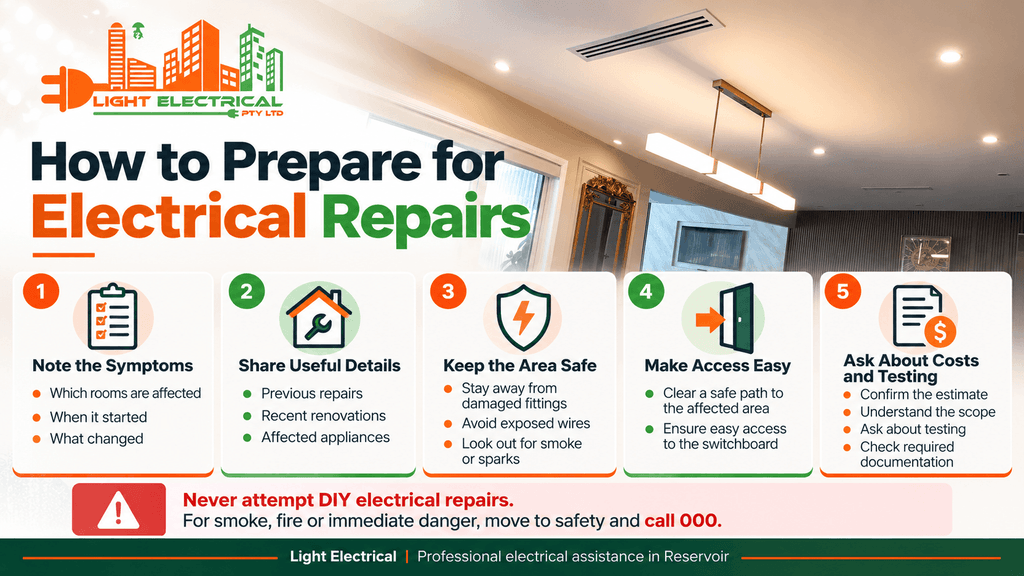
1. Electrical Repairs: Identify the Problem Before the Appointment
One of the most useful things you can do before booking electrical repairs Reservoir homeowners commonly require is to record exactly what is happening.
You do not need to identify the technical cause. Instead, focus on the symptoms and any changes you have noticed.
Make a list of the symptoms
Consider whether you have noticed any of the following:
- Lights that flicker, dim or stop working unexpectedly.
- Power points that no longer supply electricity.
- A circuit breaker or safety switch that trips repeatedly.
- A burning smell, buzzing sound or unusual heat near a switch or outlet.
- Appliances that lose power when other equipment is operating.
- Electrical problems that appear during rain or after a storm.
- A loss of power affecting one room, several rooms or the entire property.
These observations help the electrician understand the issue before beginning fault finding.
For instance, if the kitchen lights flicker only when a particular appliance is running, mention that pattern. Do not keep operating the appliance to reproduce the fault. Simply explain what you observed before the problem became apparent.
Record when the issue started
Write down a few details:
- When did you first notice the problem?
- Does it happen continuously or intermittently?
- Which rooms or fittings are affected?
- Did the problem begin after a storm, renovation or appliance installation?
- Has another electrician investigated the issue previously?
Even a short description can be useful. Instead of reporting that “the electricity keeps going off”, explain that the safety switch has tripped several times over two days and that the issue appears to affect the laundry.
Practical tip: Keep your notes on your phone so you can share them during the appointment. Photographs of visible damage can also help, provided you take them from a safe distance without touching or approaching hazardous equipment.
2. Fault Finding: Give Your Electrician the Right Information
Fault finding is the process of investigating an electrical problem to identify its underlying cause. Replacing the component that appears faulty is not always enough; a reliable repair should address the problem identified through appropriate testing.
For homeowners, the important distinction is between reporting a symptom and attempting a diagnosis.
Explain what has already been tried
Tell the electrician if you have replaced a light bulb, unplugged an appliance or noticed that a particular circuit has stopped working. Mention any previous repairs or changes to the property.
Avoid repeatedly resetting a circuit breaker or safety switch that continues to trip. A protective device may be responding to a fault, and repeatedly restoring power without identifying the cause can expose occupants to unnecessary risk.
If the switch will not reset, leave it alone and contact a licensed electrician. If you notice smoke, sparks, a burning smell or signs of overheating, treat the situation as potentially dangerous rather than waiting for a routine appointment.
Share relevant property information
A few details about your home may also help:
- Approximate age of the property.
- Whether the switchboard has been upgraded.
- Any recent renovations or new electrical installations.
- Previous issues with the same circuit.
- Whether the property has solar panels, a battery system or other relevant equipment.
Older homes can have electrical installations that have changed over many years. Recent renovations may also have introduced new appliances or altered how electrical circuits are used.
These details do not prove that the installation is faulty, but they give the electrician useful context for deciding what to inspect.
3. Electrical Safety: Make the Property Safe Before the Visit
Electrical safety should take priority over convenience. If an electrical fitting appears damaged, avoid using it and keep household members away from the affected area.
Recognise warning signs that need urgent attention
Burning smells, smoke or sparks
Stop using the affected area. If there is smoke or fire, move everyone away and call 000 in Australia when emergency services are needed. Do not touch the switchboard or attempt to investigate the source.
Electric shocks or tingling sensations
Treat even a mild shock or tingling from an appliance or metal fitting as a serious warning. Keep away from the suspected source and contact your electricity distributor and a licensed electrician for guidance.
Repeated tripping or damaged outlets
Stop using affected equipment and do not repeatedly reset protective devices. Arrange an appropriate electrical assessment; escalate immediately if there are additional signs of danger.
Energy Safe Victoria advises householders not to attempt electrical repairs themselves and to use licensed professionals for electrical work.
Keep people and pets away
If a power point is cracked, a switch is loose or a fitting appears burnt, prevent children and pets from approaching it. Do not touch exposed wiring, remove covers or attempt to place a cover over a damaged fitting yourself.
Do not enter a wet area or stand in water to investigate an electrical fault. Water and electricity can create a serious shock hazard.
If you are uncertain whether an area is safe, keep clear and explain the situation when requesting assistance.
Do not attempt DIY electrical repairs
Changing a damaged outlet, opening a switchboard or handling fixed wiring is not an appropriate preparation task for a homeowner. In Victoria, electrical installation work must be carried out by appropriately licensed electrical workers, with the relevant contractor registration requirements applying to paid work.
Your preparation should focus on observation, communication and access—not dismantling electrical fittings.
4. Preparing for Electrical Repairs in Reservoir
Preparing for Electrical Repairs in Reservoir also means making it easy for the electrician to reach the affected area and understand the property’s layout.
Clear access to the work area
Move furniture, storage boxes and other obstacles away from the affected light, power point or accessible switchboard area. Do not move anything that is damaged, wet or potentially hazardous.
If the fault is in a ceiling space, under a house or near a fixed appliance, tell the electrician where it is located. Let the professional determine whether the space can be accessed safely.
You do not need to dismantle cabinetry, remove electrical covers or climb into a roof cavity before the appointment.
Make a note of affected appliances
If the problem involves a kitchen, laundry or home office, identify the appliances that were operating when the fault occurred.
For example, a homeowner might notice that power is lost in the laundry whenever the washing machine is used. That observation is worth sharing, but it does not automatically mean the washing machine is responsible. The electrician may need to investigate the appliance, the circuit or another part of the installation.
Where it is safe to do so, stop using equipment associated with the fault. Do not reconnect it simply to demonstrate the issue.
Arrange access and household logistics
Before the appointment, consider the following:
- Make sure the electrician can reach the property.
- Secure pets in a separate, safe area.
- Let household members know that power may need to be isolated during the repair.
- Identify any essential equipment that depends on electricity.
- Inform the electrician about access restrictions or relevant hazards.
If someone works from home, has a planned online meeting or relies on powered equipment, mention this when arranging the visit. It may help with scheduling, although electrical safety must take priority over convenience.
Gather relevant records
If you have previous electrical invoices, switchboard upgrade records or documentation from earlier repairs, keep them available. You do not need to have a complete maintenance history to book an electrician.
Previous records may help establish what work has already been performed and whether the current problem relates to an earlier issue.
5. Choosing a Licensed Electrician Reservoir VIC Homeowners Can Trust
Choosing the right professional is an important part of preparing for a repair. A useful appointment begins with clear communication, but it also depends on suitable qualifications, safe working practices and transparent arrangements.
When looking for a licensed electrician Reservoir VIC residents can engage confidently, consider the following points.
Verify licensing and contractor registration
In Victoria, check that the electrical worker holds the appropriate licence for the work required. For electrical work undertaken for payment, confirm that the contractor meets the applicable Registered Electrical Contractor requirements.
Energy Safe Victoria provides information about electrical licences and a public register to help consumers check credentials.
Do not assume that someone is qualified to carry out fixed electrical work simply because they have general maintenance experience.
Ask about the proposed work
Before authorising a repair, ask the electrician to explain:
- What needs to be investigated.
- Whether testing is required before the fault can be identified.
- What repair options may be appropriate.
- Whether replacement parts or additional work may be necessary.
- What the estimated cost includes.
- Whether further work would require separate approval.
Some faults can be diagnosed quickly, while intermittent problems may require more investigation. A responsible professional should explain what is known, what remains uncertain and when additional costs might arise.
Understand the documentation
In Victoria, electrical installation work requires the relevant Certificate of Electrical Safety (COES). The certificate records details of the work and provides documentation of the electrical worker’s responsibilities. Some prescribed work also requires an independent inspection.
Ask how the certificate will be provided and retain it with your property maintenance records.
This documentation is an important part of responsible electrical maintenance, rather than an optional substitute for proper testing.
6. Emergency Electrician: Know When Not to Wait
Not every electrical fault requires an emergency callout, but some situations should never be left until a convenient appointment.
An emergency electrician Reservoir homeowners contact should be told clearly about any immediate safety concerns so the urgency can be assessed.
Situations that may require urgent assistance
Seek urgent professional guidance when you notice:
- Burning smells coming from outlets, switches or the switchboard.
- Visible sparks, smoke or signs of electrical burning.
- Repeated tripping accompanied by unusual heat or noises.
- Exposed or visibly damaged electrical wiring.
- Electric shocks or tingling sensations from appliances or fittings.
- Electrical damage following flooding, storm damage or another incident.
The appropriate response depends on the circumstances. If there is an active fire or immediate danger to life, move away and call 000. Do not approach damaged electrical equipment or attempt to extinguish an electrical fire using water.
If the danger appears to involve the incoming electricity supply, damaged overhead lines or a wider supply issue, keep clear and contact the electricity distributor as appropriate. Energy Safe Victoria advises consumers to contact their distributor for certain supply problems, including shocks and unusual voltage conditions.
What to tell the electrician when calling
Give a short, factual description of the situation:
- Your location in Reservoir.
- What happened and when it started.
- Whether there is smoke, heat, a burning smell or visible damage.
- Whether anyone has received an electric shock.
- Whether the fault affects one area or the whole property.
- Whether there has been recent water exposure or storm damage.
Do not delay seeking assistance to collect every detail. Your immediate safety comes first.
Avoid assuming a power outage is an internal fault
If your entire property loses power, the cause may be an interruption to the local electricity supply rather than a fault inside your home. If neighbouring properties are also affected, this may provide useful context, although it does not confirm the cause.
For a wider outage or suspected supply-side issue, check your electricity distributor’s outage information or contact the distributor directly. If only your property is affected, a licensed electrician may need to investigate the installation.
7. Affordable Electrical Repairs Reservoir: Plan Costs Without Compromising Safety
Managing repair costs is a reasonable concern for homeowners. However, the cheapest initial quote is not always the most economical option if it excludes necessary testing, leaves the underlying problem unresolved or creates a need for repeat visits.
The goal of affordable electrical repairs Reservoir residents can plan for is to understand the scope and cost of the work before authorising it, while maintaining appropriate safety standards.
Request a clear estimate
Ask whether the estimate includes:
- Callout or attendance fees.
- Diagnostic or fault-finding charges.
- Labour and replacement components.
- Any applicable after-hours rates.
- Testing and required documentation.
- Possible additional charges if the scope changes.
An estimate may change if the electrician discovers a separate fault or finds that additional work is required. Ask how you will be informed and whether approval will be obtained before proceeding with work outside the agreed scope.
Explain the problem accurately
A detailed description can help the electrician prepare for the appointment. If you know which room is affected, when the fault occurs and whether other fittings are involved, share that information when booking.
This does not guarantee a lower bill, but it can make the initial assessment more efficient and help avoid misunderstandings about the work requested.
Prioritise safety-related repairs
If a professional identifies a safety concern, ask for an explanation of the risk, the recommended corrective work and whether the area can remain in use safely.
Do not postpone essential safety work simply because a cosmetic improvement is also on your list. Ask the electrician to distinguish urgent repairs from optional upgrades so you can make an informed decision.
Compare quotes carefully
When comparing estimates, look beyond the total amount. Check whether the quotes cover the same work, whether testing and documentation are included, and what happens if further faults are discovered.
A quote that appears cheaper may exclude important items. Equally, a higher quote should be supported by a clear explanation of the additional work or materials involved.
Light Electrical can be considered as part of your search for professional electrical assistance in Reservoir. Discuss the symptoms, scope and pricing arrangements directly with the business rather than assuming that a particular repair will have a fixed cost.
8. Common Mistakes to Avoid Before an Electrician Arrives
Small decisions made while waiting for a repair can affect both safety and the quality of the assessment.
Mistake 1: Repeatedly resetting a tripping switch
A safety switch or circuit breaker that trips repeatedly may be responding to a fault. Do not keep resetting it to restore power. Leave the affected circuit alone and arrange professional assessment.
Mistake 2: Replacing parts without understanding the cause
A flickering light may have several possible causes. Replacing the bulb might help in some cases, but persistent flickering can indicate a problem that requires investigation. Do not open fittings or attempt wiring repairs.
Mistake 3: Waiting despite warning signs
A loose outlet may appear inconvenient rather than dangerous, but visible damage, unusual heat, sparks or a burning smell should not be ignored. Stop using the affected fitting and seek appropriate assistance.
Mistake 4: Failing to mention previous repairs
If a switchboard, power point or light fitting has recently been replaced, tell the electrician. Recent work does not necessarily explain the fault, but it is relevant information.
Mistake 5: Agreeing to unclear additional work
Ask for an explanation if the proposed repair changes after inspection. Understand the reason for the change, the likely cost and whether the additional work is necessary before authorising it, unless immediate emergency circumstances require a different response.
Mistake 6: Treating a successful power reset as proof of safety
Power returning does not necessarily mean the underlying fault has been resolved. If the same problem recurs, arrange an assessment rather than assuming the installation is safe.
9. Expert Tips for a Smoother Electrical Repair Appointment
A few practical habits can make the repair process easier without requiring technical knowledge.
Keep a simple electrical maintenance record. Note recurring faults, completed repairs, switchboard upgrades and relevant certificates. This can be particularly helpful when a problem returns months after an earlier repair.
Describe patterns rather than guessing causes. Saying that the lights dim when an appliance starts is more useful than insisting that the switchboard needs replacing. Let the electrician determine the cause through appropriate testing.
Ask what happens after the repair. Depending on the fault, the electrician may need to test the repaired circuit, check the operation of relevant protective devices or explain any limitations that remain.
Keep paperwork together. Save invoices, estimates and Certificates of Electrical Safety with your property records. If you later sell the home or arrange further electrical work, these documents may help establish what work was completed.
Discuss future concerns during the visit. If you have noticed other damaged fittings or recurring electrical issues, mention them. The electrician can explain whether they warrant separate investigation or can be included in the agreed scope.
Most importantly, do not feel that you need to understand electrical engineering before arranging a repair. Clear observations, safe access and sensible questions are enough to help you prepare.
Conclusion: Prepare Well for Safer Electrical Repairs
Preparing your Reservoir home for professional electrical repairs starts with recognising the symptoms, recording useful details and making the affected area accessible. It also means understanding when a problem needs urgent attention, avoiding unsafe DIY work and choosing a suitably qualified electrical professional.
Whether you are dealing with a faulty power point, intermittent lighting or a circuit that repeatedly trips, a clear description of the problem helps the electrician begin the investigation with useful information.
When comparing options for affordable electrical repairs Reservoir, focus on transparent pricing, appropriate qualifications, thorough fault finding and safe, compliant workmanship rather than price alone.
Light Electrical is a business Reservoir homeowners can consider when seeking professional electrical assistance. Contact the team to discuss your electrical concerns, explain the symptoms you have noticed and ask about the appropriate next steps for your property.
A well-prepared appointment can help you make informed decisions, understand the work required and maintain a safer electrical environment at home.
Frequently Asked Questions
1. How should I prepare my Reservoir home before an electrician arrives?
Start by writing down the symptoms, when the problem began and which rooms or appliances are affected. Make a note of previous repairs and recent renovations if relevant. Clear safe access to the affected area, secure pets and inform household members that electricity may need to be switched off during the work.
Do not remove outlet covers, open the switchboard or attempt to reproduce a fault. If you notice smoke, sparks, a burning smell or signs of electric shock, treat the situation as potentially dangerous and seek urgent assistance rather than waiting for a routine appointment.
2. When should I contact an emergency electrician Reservoir residents can call for urgent help?
Contact an appropriate emergency electrical service when a fault presents a potential immediate safety risk, such as exposed wiring, electrical burning, unusual heat, repeated tripping accompanied by warning signs or suspected electrical damage following water exposure.
If there is an active fire or immediate danger to life, move to safety and call 000. For electric shocks, damaged supply lines or suspected electricity network problems, keep away from the source and contact the relevant emergency service, electricity distributor and licensed electrician as appropriate.
Not every outage is an electrical emergency, but warning signs should never be ignored.
3. How can I keep electrical repair costs manageable?
Begin by describing the problem accurately and asking for a clear estimate before authorising the work. Check whether the quoted amount includes the callout, fault finding, labour, parts, testing and relevant documentation. Ask how additional costs will be handled if the investigation reveals another problem.
For affordable electrical repairs Reservoir homeowners should compare quotes based on the same scope of work, not just the final price. Avoid unlicensed DIY work or delaying essential safety repairs to save money, as either decision may expose the household to additional risk.
4. How do I check whether a licensed electrician Reservoir VIC homeowners hire is properly qualified?
Ask to see the electrician’s relevant licence details and verify them through Energy Safe Victoria’s official resources. For electrical work performed for payment, also check the applicable Registered Electrical Contractor requirements.
You can consult the official Energy Safe Victoria website for licensing and contractor information.
After electrical installation work is completed, ask for the relevant Certificate of Electrical Safety and retain it with your property records. Certain prescribed electrical work also requires independent inspection. These checks help you understand the credentials and documentation associated with the work.
5. What should I do if my circuit breaker or safety switch keeps tripping?
Do not repeatedly reset the device or continue using equipment associated with the fault. A protective device may be responding to an electrical problem, and restoring power without identifying the cause is not a reliable solution.
Record which areas have lost power and whether you noticed any warning signs before the trip. Do not open the switchboard or disconnect fixed wiring yourself. Contact a licensed electrician for assessment, and explain any burning smells, unusual heat, sparks or other signs of danger when requesting help.