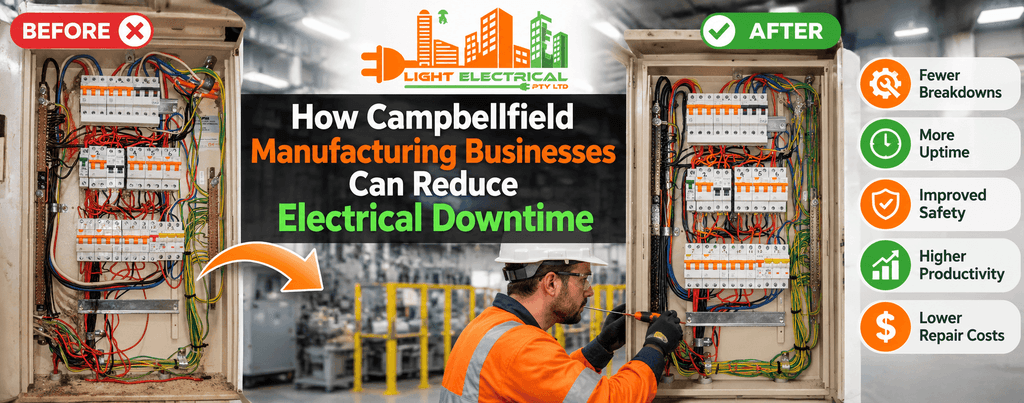
Manufacturing downtime rarely happens at a convenient time. A production line may stop halfway through a shift, a warehouse conveyor may lose power during dispatch, or a fault in a distribution board may interrupt several machines at once. Even a short interruption can affect production targets, staff schedules, delivery commitments and operating costs.
For manufacturing businesses in Campbellfield, Victoria, reducing electrical downtime requires more than reacting when equipment stops working. It involves understanding the electrical systems that support daily operations, identifying developing faults, maintaining critical equipment and ensuring that electrical work is completed by appropriately licensed professionals.
A licensed electrician Campbellfield VIC businesses can rely on can help identify electrical risks, investigate recurring faults and develop a practical maintenance approach suited to the site’s equipment and production schedule.
One particularly valuable measure is an electrical safety inspection Campbellfield manufacturers can incorporate into their broader maintenance planning. When inspections are supported by preventative maintenance, appropriate testing and accurate records, businesses have a better opportunity to identify potential problems before they cause an unexpected shutdown.
Light Electrical understands the importance of reliable electrical infrastructure in commercial and industrial environments. This guide explains practical ways Campbellfield manufacturers can reduce avoidable electrical interruptions while maintaining a safe, compliant and productive workplace.
Why Electrical Downtime Is a Serious Problem for Campbellfield Manufacturers
Manufacturing facilities depend on interconnected electrical systems. Production machinery, extraction equipment, compressors, lighting, control panels, material-handling systems and computerised equipment may all rely on a stable and appropriately designed electrical supply.
A problem affecting one component can sometimes interrupt several connected processes.
For example, a fault in a motor starter may stop a single machine. However, a fault affecting a shared distribution board could interrupt several production areas, depending on the installation’s design and protective arrangements.
The consequences can extend beyond lost production time.
Electrical downtime may lead to:
Delayed orders and missed dispatch windows.
Interrupted production runs and material wastage.
Additional labour costs when shifts must be extended.
Damage to sensitive equipment following certain electrical faults.
Disruption to ventilation, extraction or other essential systems.
Increased pressure on maintenance teams and production supervisors.
Potential safety risks when workers attempt unsuitable temporary repairs.
The financial impact depends on the facility’s production rate, equipment dependencies, recovery time and the nature of the fault. Rather than assuming every interruption has the same cost, manufacturers should record the actual duration, affected processes and resulting losses.
This information helps maintenance managers prioritise improvements based on operational impact rather than treating every electrical issue as equally urgent.
1. Identify the Electrical Systems That Could Stop Production
The first step towards reducing downtime is understanding which electrical components are essential to keeping the facility operational.
Not every circuit or machine has the same importance. A failure affecting a critical production line may have a greater business impact than a fault affecting a non-essential office circuit.
Map critical equipment and power dependencies
Manufacturers should work with their maintenance team and a qualified electrical professional to identify:
Main switchboards and distribution boards.
Production machinery and motor control centres.
Compressors, pumps and extraction systems.
Conveyor systems and warehouse equipment.
Programmable logic controllers (PLCs) and control circuits.
Essential lighting and safety-related electrical systems.
Backup power arrangements, where installed.
Equipment that cannot restart immediately after a power interruption.
The objective is to understand how these systems depend on one another.
For instance, a packaging machine may be operational but unable to run because its upstream conveyor has stopped. Similarly, a group of machines may depend on one shared electrical supply, meaning a single fault can affect an entire production area.
A basic equipment register should identify each critical asset, its electrical supply, maintenance history, known recurring faults and the consequences of failure.
Establish which failures require the fastest response
A useful starting point is to classify equipment according to the consequences of losing it.
Priority
Example
Maintenance approach
Critical
Main production equipment or an essential shared supply
Planned inspections, appropriate monitoring and a documented response plan
Important
Equipment that limits production capacity when unavailable
Scheduled servicing and prompt investigation of recurring faults
Supporting
Non-critical equipment with limited operational impact
Routine maintenance based on condition and manufacturer guidance
This classification should reflect the facility’s actual operating conditions and safety obligations. It should not be used to postpone urgent electrical hazards.
2. Work With a Licensed Electrician Campbellfield VIC Businesses Can Trust
Industrial electrical systems can be more complex than those found in typical residential properties. They may include three-phase supplies, large motors, variable-speed drives, industrial control systems and multiple distribution boards.
These installations require an appropriate understanding of electrical design, protection, testing and the specific equipment involved.
Engaging a licensed electrician Campbellfield VIC manufacturers can work with helps ensure that electrical installation, repair and maintenance tasks are handled by a professional with the relevant Victorian licensing or registration for the work.
Why industrial experience matters
A recurring production fault does not always originate in the machine that stops.
Consider a conveyor that intermittently shuts down during periods of heavy use. The cause might involve a motor overload, a loose or deteriorating connection, a control-circuit issue, a failing component or a problem elsewhere in the supply system.
Replacing the motor immediately may not solve the underlying problem.
A systematic investigation considers the operating conditions, fault indications, protective devices, control signals and available maintenance history. The electrician can then determine what testing is appropriate and identify the cause before recommending corrective work.
This approach can reduce unnecessary component replacement and help prevent the same fault from returning.
What to discuss before electrical work begins
When selecting an electrical contractor, manufacturing businesses should ask about:
Relevant Victorian electrical licences or registrations.
Experience with the site’s type of machinery and electrical infrastructure.
Testing procedures and the documentation provided after work.
Safe work methods, isolation arrangements and coordination with site personnel.
Availability for planned maintenance and urgent breakdowns.
Familiarity with the relevant equipment manufacturer’s requirements.
Light Electrical can be considered as part of a manufacturer’s contractor evaluation, with the suitability of any proposed work confirmed against the facility’s specific requirements.
3. Schedule an Electrical Safety Inspection Campbellfield Manufacturers Can Use Proactively
An electrical safety inspection Campbellfield manufacturing facilities arrange should support both workplace safety and the early identification of electrical problems.
Inspections are most useful when they are appropriate to the installation, performed by suitably qualified professionals and followed by documented corrective actions.
They should not be treated as a guarantee that equipment will never fail. Instead, inspections help identify observable defects, deterioration and other concerns that warrant investigation.
What should an inspection consider?
The inspection scope depends on the installation, the equipment present and the relevant legal and technical requirements. It may include assessment of:
Switchboards, enclosures and accessible electrical connections.
Signs of overheating, discolouration or physical deterioration.
Circuit protection and the condition of electrical components.
Earthing and bonding arrangements, where applicable.
Electrical cables, conduits and exposed wiring.
Isolation provisions and access to electrical equipment.
Previous fault reports and outstanding maintenance issues.
Changes to machinery, circuits or production layouts.
Electrical equipment operating in dusty, hot, wet or otherwise demanding conditions.
Some checks require instruments, isolation or specific testing procedures. They should not be attempted by unqualified staff or performed on energised equipment without appropriate authorisation, controls and competence.
Why inspection records matter
An inspection report should clearly distinguish between identified defects, recommended improvements and work requiring further investigation.
For each significant finding, the maintenance team should record the affected equipment, the risk or operational consequence, the recommended action, the person responsible and the target completion date.
For example, if a switchboard shows signs of abnormal heating, the business should not simply record the observation and return to normal operations. A competent professional should assess the condition, determine the urgency and recommend appropriate corrective measures.
The inspection process becomes much more valuable when findings are tracked through to completion.
4. Invest in Preventative Maintenance Instead of Waiting for Breakdowns
Preventative maintenance involves servicing and checking equipment at planned intervals to reduce the likelihood of failure. In manufacturing environments, it is an important part of controlling avoidable electrical downtime.
However, effective maintenance is not simply about inspecting every component as frequently as possible. It requires a schedule based on equipment criticality, manufacturer recommendations, operating conditions, previous failures and the consequences of an interruption.
Build a practical electrical maintenance schedule
A structured maintenance programme may include:
Routine visual checks: Identify visible damage, unusual odours, warning indicators or signs of overheating without opening electrical enclosures or touching exposed components.
Scheduled electrical inspections: Arrange appropriate professional inspections and testing based on the installation’s condition and risk profile.
Switchboard servicing: Have qualified personnel assess switchboards, protective devices, connections and other components according to the equipment requirements and safe work procedures.
Motor and drive assessments: Investigate abnormal vibration, overheating, unexpected trips or changing operating behaviour.
Control-system checks: Review recurring alarms, sensor faults and control-circuit problems that interrupt production.
Corrective maintenance: Track identified defects and ensure that necessary repairs are completed within an appropriate timeframe.
The schedule should be documented and reviewed when production requirements, equipment or operating conditions change.
Use equipment history to improve maintenance decisions
Suppose a manufacturing business experiences three unexpected shutdowns involving the same motor over six weeks.
A reactive approach might reset the protection and restart the machine each time. A more effective approach records the fault, investigates the operating conditions and determines whether the underlying cause involves excessive load, mechanical resistance, electrical supply conditions, control issues or another problem.
The appropriate response depends on the evidence. Repeatedly resetting a protective device without investigating why it operated can allow a developing fault to remain unresolved.
By reviewing maintenance history, businesses can identify recurring patterns and make better decisions about repairs, servicing intervals and equipment replacement.
5. Improve Switchboard Servicing and Power Distribution Reliability
Switchboards and distribution equipment are central to a manufacturing facility’s electrical infrastructure. Their condition can influence the reliability of multiple machines and production areas.
A problem affecting a shared supply may have a much wider operational impact than a fault isolated to one item of equipment.
Recognise the warning signs
Manufacturing staff should report concerns such as:
Repeated circuit-breaker or protective-device trips.
Burning smells or visible discolouration near electrical equipment.
Unusual buzzing, crackling or other unexpected sounds.
Flickering lights or unexplained changes in equipment behaviour.
Repeated machine resets or unexplained control-system alarms.
Visible damage to electrical enclosures or cabling.
These symptoms do not establish a particular fault on their own. They are reasons to arrange an appropriate assessment.
If there is smoke, arcing, a burning smell associated with electrical equipment or another immediate danger, follow the site’s emergency procedures, keep personnel away and contact emergency services when necessary. Do not open switchboards or attempt unauthorised repairs.
Review power distribution as production grows
Adding machinery or increasing operating hours can change the demands placed on an electrical installation.
A new machine may introduce additional load, starting currents, harmonics or other electrical characteristics that need to be considered. Simply connecting equipment to an apparently available circuit does not establish that the installation is suitable.
Before commissioning new machinery, have a qualified professional assess the relevant supply capacity, protective arrangements, cable sizing, earthing and other applicable requirements.
This is especially important when production lines are expanded, equipment is relocated or multiple high-demand machines are introduced.
6. How a Commercial Electrician Campbellfield Businesses Choose Can Help Reduce Downtime
Manufacturing facilities often depend on more than production machinery alone. Office areas, staff amenities, lighting systems, workshop equipment and shared electrical infrastructure also contribute to daily operations. When electrical problems affect these areas, they can create interruptions that extend beyond the immediate fault.
A commercial electrician Campbellfield businesses engage should understand the requirements of the electrical work involved and have the appropriate qualifications and experience for the installation. Depending on the facility, relevant work may include investigating lighting faults, maintaining commercial electrical infrastructure, assessing distribution boards and addressing problems affecting office or support areas.
For example, a fault affecting lighting or electrical equipment in a dispatch area may disrupt staff activities even when the main production machinery remains operational. Identifying these issues early and coordinating repairs with site management can help minimise avoidable disruption.
Manufacturers should also review electrical requirements when extending office areas, relocating equipment or introducing additional loads. An appropriately qualified electrician can assess the proposed work and determine whether the existing installation is suitable.
The objective is to coordinate commercial electrical maintenance with production needs while maintaining safe working conditions and applicable compliance requirements.
7. Why an Industrial Electrician Campbellfield Manufacturers Rely On Is Essential for Fault Finding
Industrial electrical faults can be difficult to diagnose because production machinery often combines power circuits, control systems, motors, sensors and protective devices. A fault affecting one component may prevent an entire process from operating.
An industrial electrician Campbellfield manufacturers engage should have the relevant competence and experience to investigate the specific equipment and electrical systems involved.
Consider a production conveyor that stops intermittently during a busy shift. Replacing the motor immediately may not resolve the problem if the actual cause involves a control circuit, a protective device, an electrical supply issue or excessive mechanical load.
A systematic electrical fault-finding process starts by reviewing the symptoms, fault history and equipment documentation. Appropriate inspection and testing can then help identify the underlying cause and determine the necessary corrective action.
Industrial maintenance should also consider the relationship between connected machines. A fault affecting a shared power supply or control system may interrupt several production stages, so the investigation should account for the wider installation rather than focusing exclusively on the machine that stopped.
By combining documented fault investigations with preventative maintenance, manufacturers can make more informed decisions about repairs, equipment servicing and future reliability improvements
8. Consider the Specific Needs of a Warehouse Electrician
Manufacturing facilities often include storage and dispatch areas where electrical interruptions can affect stock movement, order preparation and delivery schedules.
A warehouse electrician may work on relevant systems such as conveyor supplies, loading-area lighting, dock equipment, warehouse distribution boards and electrical infrastructure supporting material handling, subject to their qualifications and the work involved.
Reduce downtime in material-handling areas
Warehouse operations may depend on several connected systems. A conveyor can be electrically healthy but remain unavailable because of a control fault, a failed upstream process or an interruption to another connected system.
Maintenance planning should therefore consider the wider workflow, not just individual equipment.
Practical measures include:
Maintaining accurate records of recurring conveyor and motor faults.
Checking that changes to warehouse layouts are assessed before electrical equipment is relocated.
Scheduling maintenance around dispatch requirements where practicable.
Ensuring that essential electrical panels and isolation points remain accessible.
Reviewing the condition of lighting and electrical equipment in demanding environments.
Confirming that any backup or alternative operating arrangements are suitable and safely implemented.
Where warehouse equipment is critical to production, include it in the same asset register and maintenance prioritisation process used for production machinery.
9. Establish an Emergency Electrician Response Plan
Even well-maintained facilities can experience unexpected electrical failures. A documented response plan helps staff act consistently when an interruption occurs.
An emergency electrician may be required when a sudden electrical fault creates an immediate operational or safety concern. Availability and response times depend on the contractor and circumstances, so manufacturers should confirm arrangements in advance rather than assume immediate attendance.
What the response plan should cover
The plan should establish:
Who can report and escalate an electrical fault.
Who has authority to stop affected operations.
How workers should maintain a safe distance from suspected hazards.
Which electrical contractor should be contacted.
How affected equipment and circuits are identified.
Who coordinates isolation and safe access.
How the repair and return to service are authorised.
What records must be completed after the incident.
After a shutdown, capture the time of the interruption, the equipment affected, alarm messages, relevant operating conditions and the steps taken. Only collect this information where it can be done safely.
These records support a more effective investigation and help the business determine whether further maintenance or engineering changes are warranted.
10. Avoid Common Mistakes That Increase Electrical Downtime
Some maintenance practices can unintentionally increase both operational risk and the likelihood of recurring faults.
Treating repeated trips as routine
A protective device that trips repeatedly is providing information about an abnormal condition. Resetting it without investigation does not resolve the underlying problem.
Better approach: Record the symptoms, follow site procedures and arrange assessment by a suitably qualified electrician.
Waiting until equipment fails completely
Visible deterioration, recurring alarms and unusual operating behaviour can sometimes provide early warning of a developing issue.
Better approach: Create a clear reporting process and investigate abnormal conditions before they become routine.
Scheduling maintenance without reviewing production dependencies
Work on a shared distribution board may affect more equipment than the maintenance team initially expects.
Better approach: Review electrical drawings, identify connected loads and coordinate the outage with the relevant operational teams.
Assuming a visual inspection is enough
A visual check cannot establish the condition of every electrical component or confirm that all required testing has been completed.
Better approach: Determine the inspection and testing requirements for the installation, and retain the resulting records.
Allowing temporary repairs to become permanent
Temporary arrangements can introduce additional risks if they are not properly assessed, documented and resolved.
Better approach: Ensure repairs and modifications are appropriate for the installation and that any temporary measures are authorised, controlled and removed or replaced as required.
Ignoring changes to machinery or production loads
Equipment additions and layout changes can affect circuit loading, protection and the suitability of existing electrical infrastructure.
Better approach: Arrange an electrical assessment before making significant changes to the installation.
11. Meet Electrical Compliance Requirements Without Losing Sight of Reliability
Electrical compliance and operational reliability are closely related, but they are not interchangeable. A compliant installation can still experience equipment failure, while a machine that appears to operate normally may have an underlying safety defect.
Manufacturers should address both obligations through appropriate inspections, maintenance, documentation and risk management.
In Victoria, businesses should consider the applicable requirements under the Electricity Safety Act 1998, the Electricity Safety (General) Regulations 2019, relevant occupational health and safety legislation, and applicable electrical standards. The exact obligations depend on the installation, work being performed and circumstances.
Maintain useful electrical records
A well-organised electrical maintenance register should include:
Equipment identification and location.
Inspection and testing dates.
Identified defects and recommended corrective actions.
Repairs, replacements and modifications.
Relevant test results and completion records.
Outstanding maintenance tasks and responsible personnel.
Recurring faults and associated downtime.
Relevant contractor and equipment documentation.
These records help maintenance managers understand the installation’s history, demonstrate appropriate follow-up and make informed decisions about future maintenance.
Where an installation or particular type of electrical work has specific inspection, certification or testing requirements, those requirements must be addressed separately. A general maintenance inspection should not be represented as a substitute for a legally required inspection or certificate.
12. Measure Electrical Downtime to Improve Long-Term Performance
Manufacturers cannot effectively reduce downtime without understanding how frequently interruptions occur and how much production time they consume.
A small set of operational measures can help identify where maintenance improvements will have the greatest impact.
Metric
What it tells you
How to use it
Electrical downtime hours
Total production time lost to electrical issues
Compare periods and identify recurring problems
Fault frequency
How often electrical interruptions occur
Prioritise repeatedly affected assets
Mean time to repair (MTTR)
Average time required to restore equipment after failure
Identify opportunities to improve diagnosis and repair processes
Mean time between failures (MTBF)
Average operating time between failures for a defined asset or system
Assess reliability trends where failure data is available
For example, if a production line experiences fewer breakdowns but takes longer to recover from each incident, the business may need to improve access to technical documentation, fault records, spare parts or contractor support.
Conversely, a high repeat-fault rate may indicate that maintenance teams are treating symptoms rather than resolving underlying causes.
Review these measures regularly and use them to refine the maintenance plan. The objective is not simply to complete more maintenance tasks, but to reduce avoidable interruptions while maintaining safe operating conditions.
Expert Advice: Build a Downtime Reduction Plan Around Your Facility
For Campbellfield manufacturing businesses, the most practical approach is to combine electrical risk management, scheduled maintenance and reliable breakdown response.
The following sequence provides a useful starting point.
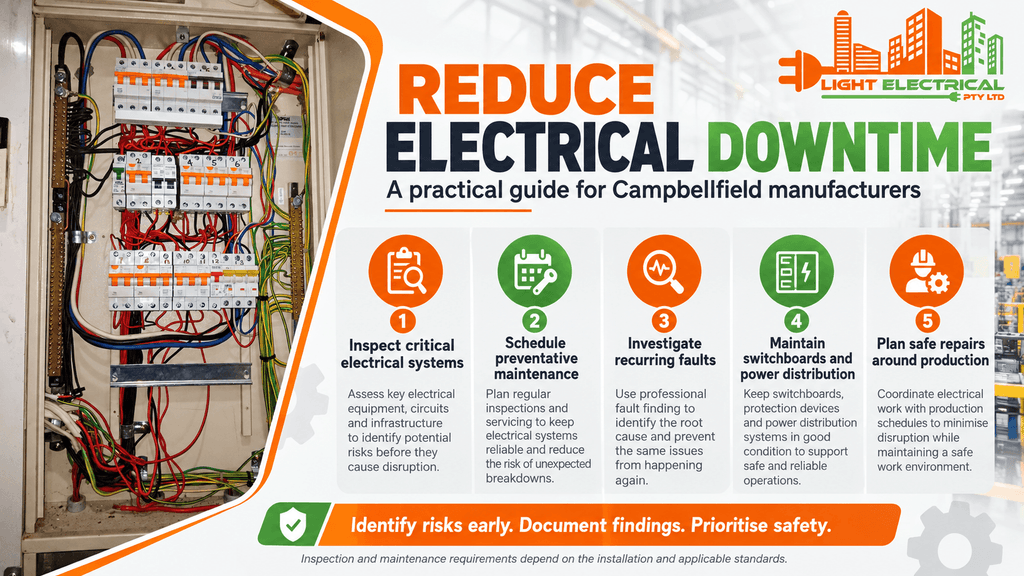
Step 1: Establish a baseline. Review recent electrical interruptions and identify the assets responsible for the greatest production losses.
Step 2: Inspect critical infrastructure. Arrange an appropriately scoped electrical assessment, prioritising equipment and circuits with significant safety or operational consequences.
Step 3: Address urgent defects. Ensure hazardous conditions and significant faults receive the appropriate response rather than remaining on a routine maintenance list.
Step 4: Create an asset-specific schedule. Use manufacturer recommendations, equipment condition, operating hours and fault history to determine maintenance activities and intervals.
Step 5: Improve fault reporting. Give staff a straightforward method for reporting abnormal sounds, repeated trips, warning indicators and unexplained equipment stoppages.
Step 6: Coordinate planned work. Align maintenance with production requirements while preserving all necessary isolation, testing and safety procedures.
Step 7: Review the results. Compare downtime, repeat faults and maintenance completion over time to determine whether the measures are working.
The right schedule will differ between a small fabrication workshop, a large manufacturing plant and a warehouse with automated handling equipment. A facility-specific plan is more useful than applying the same maintenance intervals to every asset.
Conclusion: Make Electrical Reliability Part of Your Production Strategy
Reducing electrical downtime requires a planned approach that combines early fault identification, appropriate inspections, preventative maintenance and effective breakdown response.
For licensed electrician Campbellfield VIC manufacturers, the starting point is understanding which electrical systems are most critical to production, maintaining accurate equipment records and ensuring that faults receive the right level of investigation.
An electrical safety inspection Campbellfield businesses arrange as part of a broader maintenance programme can help identify concerns that warrant attention. When supported by professional fault finding, appropriate switchboard servicing and a facility-specific maintenance schedule, inspections can contribute to safer and more reliable operations.
Light Electrical recognises the importance of dependable electrical infrastructure for businesses that rely on their equipment every day. Manufacturers can contact Light Electrical to discuss their electrical maintenance needs and determine an appropriate approach for their facility.
The goal is straightforward: identify problems earlier, resolve faults properly and make electrical reliability a planned part of keeping production moving.
Frequently Asked Questions
1. How can a licensed electrician help reduce manufacturing downtime in Campbellfield?
A suitably licensed electrician can help identify electrical defects, investigate recurring faults, assess relevant electrical infrastructure and carry out appropriate repairs or maintenance. Depending on the installation and the professional’s competencies, this may include work involving switchboards, motor circuits, distribution systems and industrial equipment.
The greatest benefit often comes from investigating repeated problems instead of simply restoring power. By documenting findings, identifying underlying causes and recommending suitable corrective actions, the electrician can help a business make better maintenance decisions. Results depend on the nature of the faults, the equipment and the maintenance measures implemented.
2. How often should a manufacturing business arrange an electrical safety inspection?
There is no single inspection interval suitable for every manufacturing facility. The appropriate frequency depends on the installation, equipment condition, environmental exposure, operating conditions, risk assessment, applicable legal obligations and manufacturer recommendations.
A facility with heavy machinery, high operating hours or demanding environmental conditions may require a different inspection and testing programme from a small workshop with less complex equipment. Businesses should consult a suitably qualified electrical professional to establish the appropriate scope and frequency. They should also arrange prompt assessment whenever damage, repeated trips, overheating or other concerning symptoms appear.
3. What are the most common causes of electrical downtime in manufacturing facilities?
Potential causes include deteriorating electrical connections, overloaded circuits, motor faults, failed components, control-circuit problems, protective-device operation and issues involving power distribution. Equipment changes, demanding operating conditions and inadequate maintenance can also contribute to interruptions.
However, a shutdown does not automatically identify its cause. For example, a motor stopping unexpectedly could involve the motor itself, its supply, a control signal, a protective device or a mechanical problem affecting operation. A structured fault-finding process helps distinguish between these possibilities and guides the appropriate corrective action.
4. What is the difference between preventative electrical maintenance and emergency repairs?
Preventative maintenance involves planned inspections, servicing and other appropriate activities intended to identify deterioration and reduce the likelihood of avoidable failures. Emergency repairs address an unexpected fault or urgent electrical problem after it occurs.
Both are necessary, because preventative maintenance cannot eliminate every failure. However, relying exclusively on emergency repairs can make it harder to plan production, manage maintenance costs and identify recurring problems.
A balanced programme combines scheduled maintenance with clear breakdown procedures, appropriate contractor arrangements and records that help prevent the same fault from repeatedly interrupting operations.
5. Can electrical maintenance be completed without stopping production?
Some electrical maintenance activities can be performed without interrupting production, depending on the equipment, work scope and safe operating conditions. Other tasks require equipment shutdown, electrical isolation or a planned outage.
The decision must be based on a proper assessment of the work and the risks involved, not solely on production requirements. Manufacturers should coordinate with their electrical contractor to determine which tasks can be undertaken during normal operations and which require a controlled shutdown.
Where an outage is necessary, planning it around an appropriate maintenance window can help reduce operational disruption. Required isolation, testing and verification must never be bypassed to keep a production line running.
At Light Electricians Pty Ltd., we care about our clients and helping them get peace of mind knowing that your electricians system is working properly. Our technicians are licensed, trained, and skilled to handle any electricians project, no matter how big or small. Our electricians design, install, service, and repair electricians systems and parts in strict accordance with the highest industry standards. Our team knows you’re busy, and your time is valuable.
Contact Light Electricians Pty Ltd. today to get a competitive quote for the best brand of safety switches and switchboard upgrades, whether you want to do a major upgrade or need to replace all your circuit breakers with safety switches. We are committed to absolute professionalism and take great pride in our customers' satisfaction. Don't wait to get your switchboard upgraded contact us today.