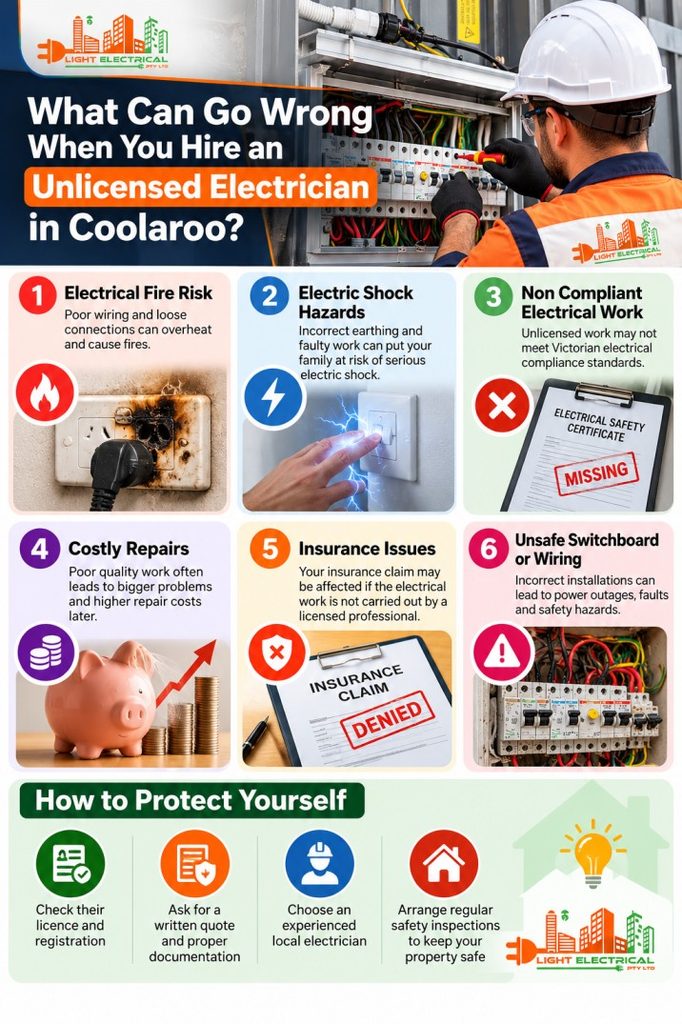
Hiring an electrician might seem straightforward until a small repair turns into a safety concern, an unexpected expense or a problem with your insurance. Electrical work affects much more than whether a light turns on or a power point works. Poor workmanship can create hidden hazards inside walls, overload circuits and leave a property with electrical defects that are expensive to correct.
For homeowners, landlords and business owners, choosing a licensed electrician in Coolaroo VIC is an important step towards protecting people, property and electrical systems. While an unlicensed worker may offer a cheaper quote, the initial saving can disappear quickly if the work needs to be repaired, inspected or completely redone.
So, what can actually go wrong when you hire someone who is not appropriately licensed? The risks include unsafe wiring, faulty electrical work, non-compliant installations, complications with insurance claims and difficulty obtaining the required electrical safety documentation.
Understanding these risks helps you make a more informed decision before approving any electrical job. This guide explains the warning signs to look for, how licensing protects property owners and what practical steps you can take to arrange safer residential electrical services in Coolaroo.
Why Choosing a Licensed Electrician in Coolaroo Matters
Electrical systems are designed to operate within specific safety limits. Every circuit, cable, switchboard and protective device must work correctly with the rest of the installation. When one component is incorrectly installed or poorly selected, the problem may affect more than the immediate repair.
In Coolaroo, as in other Melbourne suburbs, electrical work can range from replacing a damaged power point to installing new circuits, upgrading a switchboard or addressing an electrical fault. These jobs require different levels of technical knowledge, testing and regulatory compliance.
A person who can replace a household fitting is not automatically qualified or authorised to carry out every type of electrical installation work.
Victoria regulates electrical workers and electrical contractors through Energy Safe Victoria (ESV). Property owners can check licences and registrations through the regulator’s public registers.
Before accepting a quote, make sure the person undertaking the work has the appropriate licence and that the contracting business meets the relevant registration requirements.
1. What Electrical Safety Risks Can an Unlicensed Electrician Create?
The most serious risk is an installation that appears to work but is not electrically safe.
A light may turn on, a power point may charge a phone, and a circuit breaker may remain switched on. None of these observations proves that the installation is safe. Some defects remain hidden until a circuit is heavily loaded, a fault develops, or someone touches a defective component.
Faulty electrical work and fire hazards
Poor electrical connections can create resistance and heat. Incorrect cable selection, unsuitable protective devices or damaged insulation can also increase the risk of overheating and electrical fires.
Consider a homeowner who needs an additional power point in a home office. A low-cost worker installs it by connecting it incorrectly to an existing circuit. The power point initially works, but the circuit may be unsuitable for the connected load, or the installation may contain a loose connection.
The homeowner may not notice anything wrong until the equipment has been operating for several hours.
A qualified electrician assesses the existing circuit, selects appropriate materials, completes the installation correctly and performs the required tests. This is particularly important when adding outlets for computers, heaters or other equipment that draws substantial current.
Electric shocks and unsafe connections
Incorrect earthing, defective wiring and unsuitable protective devices can expose occupants to electric shock.
Safety switches, also known as residual current devices (RCDs), provide important protection by detecting certain electrical leakage conditions and disconnecting the supply. However, installing a safety switch does not automatically make every part of an electrical system safe.
An electrician must consider the condition of the installation, the type of protection required, and whether the relevant devices operate correctly.
Practical advice: If a power point feels unusually hot, you notice a burning smell, hear persistent electrical buzzing, or see scorch marks, stop using the affected equipment or circuit if it is safe to do so. Do not remove covers or touch exposed wiring. If there is smoke, fire, or immediate danger, move away and call emergency services.
2. How Can Faulty Electrical Work Lead to Expensive Repairs?
The second major risk is the cost of correcting work that was never completed properly.
An inexpensive quote may cover only the visible task, leaving out circuit testing, suitable materials, fault diagnosis, or the work needed to bring an affected installation into compliance.
When another electrician investigates the problem, they may discover defects beyond the original repair.
For example, a homeowner might pay for a replacement light fitting, only to discover later that the connections behind it are damaged and the circuit requires further investigation. The original payment has not solved the underlying problem, and a second visit becomes necessary.
Common defects that may require rework
- Incorrectly sized cables or unsuitable circuit protection.
- Loose or poorly terminated electrical connections.
- Damaged insulation or exposed conductive parts.
- Incorrectly installed switches, outlets or light fittings.
- Missing or inadequate earthing arrangements.
- Poorly labelled circuits that make safe isolation more difficult.
- Incomplete testing or missing electrical safety documentation.
Not every inexpensive job is poor quality, and a high quote does not guarantee good workmanship. The important distinction is whether the price covers the work required to achieve a safe, compliant result.
Ask for an itemised quote that explains the proposed work, materials, testing and any exclusions. If an electrician identifies additional defects, request an explanation and photographs where practical before authorising further work.
When should you obtain a second opinion?
Seek an independent assessment if the original worker refuses to explain what was done, repeatedly returns without resolving the fault, or dismisses clear warning signs without investigating them.
A qualified professional can determine whether the problem is limited to one fitting or whether the wider circuit requires attention.
For homeowners comparing contractors, Light Electrical can be considered alongside other appropriately qualified providers. The key is to assess licensing, scope of work, documentation and the clarity of the proposed solution rather than price alone.
3. What Happens When Electrical Work Fails Compliance Requirements?
Electrical compliance means more than making an installation function. The work must meet the applicable legal requirements, technical standards and safety obligations.
An unlicensed person may not be authorised to perform the work in question or issue the required documentation. If the installation is defective, the property owner may need to pay another qualified contractor to investigate and correct it.
Understanding Certificates of Electrical Safety
In Victoria, a Certificate of Electrical Safety (COES) is required for electrical installation work. It records the work undertaken and supports accountability for its safety and compliance.
There are two relevant categories:
- Non-prescribed electrical installation work: This includes many ordinary jobs involving lights, power points and certain electrical equipment. The licensed worker must complete and test the work before certifying it. An independent inspection is not routinely required for this category.
- Prescribed electrical installation work: This includes certain major work involving consumer mains, switchboards, meter boxes and earthing systems, as well as specified solar and battery installations. An independent licensed electrical inspector must inspect the work.
The exact category depends on the work performed, not simply on how long the job takes.
A certificate is not a substitute for good workmanship, but it provides a formal record of the electrical work. For prescribed work, the independent inspection adds another level of scrutiny.
Why missing documentation matters
Suppose a property owner arranges a substantial electrical upgrade and receives an invoice but no Certificate of Electrical Safety. The contractor becomes difficult to contact, leaving the owner without the expected documentation.
This can complicate future maintenance, property transactions or investigations into the installation. The owner may need to contact Energy Safe Victoria or engage another qualified electrician to establish what was done and whether further assessment is necessary.
Keep copies of:
- The accepted quote and final invoice.
- The electrician’s licence and contractor details.
- The Certificate of Electrical Safety.
- Any inspection records required for prescribed work.
- Relevant photographs and maintenance records.
If you have paid for electrical installation work and have not received the required certificate, request it from the electrician or contractor. Energy Safe Victoria provides guidance on obtaining missing certificates and reporting compliance concerns.
4. Can Unlicensed Electrical Work Affect Insurance Compliance?
Insurance is another concern, especially when a property suffers damage following an electrical fault.
An insurer may investigate the cause of a fire, equipment failure or other loss. If the investigation identifies defective wiring or unauthorised electrical work, questions may arise about the circumstances of the incident and the property’s compliance with relevant policy conditions.
However, it is important not to assume that every insurance claim involving defective electrical work will automatically be rejected. The outcome depends on the policy wording, the facts of the incident and the applicable law.
What property owners should do
If you discover that electrical work may have been completed by an unlicensed person:
- Stop using any affected circuit or equipment if you suspect it is unsafe.
- Arrange an assessment by an appropriately licensed electrician.
- Keep invoices, messages, photographs and other records of the original work.
- Ask the electrician to document identified defects and any corrective work.
- Contact your insurer if the situation may affect an existing or potential claim.
For landlords and property managers, documentation is especially useful because electrical maintenance may involve several contractors over time.
Important distinction: Using a licensed contractor supports compliance and accountability, but it does not guarantee that an insurer will cover every loss. Review your policy and contact your insurer when you need a definitive answer about your particular circumstances.
5. Why Switchboard Upgrades Coolaroo Require Qualified Professionals
A switchboard distributes electricity throughout a property and provides protection for individual circuits. If it is outdated, damaged or incorrectly modified, it may not provide the level of protection required for the installation.
A switchboard upgrade is not simply a matter of replacing old switches with new ones. The electrician must assess the existing installation, identify relevant defects, select suitable protective devices and complete the required testing and certification.
What can go wrong with an incorrectly installed switchboard?
Poorly performed switchboard work may result in:
- Incorrectly connected circuits.
- Inadequate circuit protection.
- Defective earthing arrangements.
- Loose connections that overheat.
- Missing or incorrectly installed safety switches.
- Unsafe reconnection before the required independent inspection.
Energy Safe Victoria identifies switchboard replacement as prescribed electrical installation work requiring inspection by an independent licensed electrical inspector before the new switchboard is re-energised.
For property owners considering switchboard upgrades Coolaroo, the practical lesson is to ask who will perform the work, who will arrange the inspection and when the electrical supply can safely be restored.
Do not accept assurances that a new switchboard is compliant simply because it looks modern or the power comes back on.
6. When Should You Call an Emergency Electrician Coolaroo?
Electrical emergencies need prompt attention because the underlying fault may pose a risk even when the symptoms appear minor.
An emergency electrician Coolaroo may be needed when a property experiences repeated circuit trips, burning smells near electrical equipment, damaged wiring, or a sudden loss of power associated with an electrical fault.
Warning signs you should never ignore
Watch for these signs around your property:
- Lights that flicker repeatedly without an obvious explanation.
- Power points that feel hot or show scorch marks.
- Circuit breakers or safety switches that repeatedly trip.
- Buzzing or crackling sounds from electrical fittings.
- Tingling sensations when touching an appliance or metal fixture.
- Damaged cables, exposed conductors or water affecting electrical equipment.
A single tripped breaker does not always indicate a serious fault. However, repeated tripping should be investigated rather than treated as an inconvenience.
Energy Safe Victoria advises property owners to contact a licensed electrician for electrical problems and avoid attempting electrical repairs themselves.
If you notice smoke, fire or an immediate threat to life, move to safety and call 000. Never touch damaged electrical equipment or approach fallen powerlines.
Why choosing the right emergency electrician matters
Under pressure, it is tempting to accept the first person promising an immediate, inexpensive repair. However, speed should not replace verification.
Before authorising work, ask whether the person holds the appropriate electrical licence and whether the business is properly registered to undertake the contracted work. Request a clear explanation of the fault and the proposed repair.
A competent emergency response should address the immediate danger and identify whether further testing or repairs are necessary. Simply restoring power without investigating a recurring fault may leave the underlying problem unresolved.
7. How a Local Electrician Supports Electrical Compliance
Choosing a local electrician can make it easier to arrange follow-up visits, discuss previous repairs and obtain records for future maintenance. However, being local does not automatically mean a tradesperson is qualified.
For homeowners seeking a licensed electrician in Coolaroo VIC, the priority should be appropriate qualifications, relevant experience, contractor registration and clear communication.
What should a professional electrical assessment include?
Depending on the reported issue and the agreed scope, an assessment may involve:
- Reviewing the affected circuit and electrical equipment.
- Visually checking accessible wiring and connections.
- Testing relevant protective devices.
- Checking earthing, insulation resistance and circuit connections where applicable.
- Identifying defects that require corrective work.
- Explaining any recommended repairs and their urgency.
- Providing the appropriate electrical safety documentation for completed installation work.
Energy Safe Victoria’s technical guidance describes several verification tests used to establish whether electrical installations are safe to connect to a supply, including earthing continuity, insulation resistance, polarity, circuit connections and residual current device operation. The specific tests depend on the installation and work undertaken.
A safety inspection should also be clearly defined before it begins. A visual inspection alone is not necessarily equivalent to a comprehensive electrical assessment, and a routine rental-property safety check is not the same as a Certificate of Electrical Safety for repair work.
Ask the electrician to explain what will be inspected, which tests are included, and whether any limitations apply.
8. What to Check Before Hiring a Licensed Electrician
A few straightforward checks can help you avoid unnecessary risks when arranging residential electrical services in Coolaroo.
Step 1: Verify the licence
Ask to see the electrician’s licence and confirm that it covers the work you need. Energy Safe Victoria provides public registers for checking electrical workers and registered electrical contractors.
Step 2: Confirm the contractor’s registration
Where a business is contracting to perform electrical installation work for payment, verify the applicable Registered Electrical Contractor (REC) registration requirements. Do not assume an advertised business name alone establishes registration.
Step 3: Request a written quote
The quote should explain the proposed work, materials, labour, testing, documentation and exclusions. Ask whether additional defects will require separate approval before further work begins.
Step 4: Ask about testing and certification
Confirm that the electrician will carry out the required testing and provide the relevant Certificate of Electrical Safety for completed electrical installation work.
If the job involves prescribed work, ask how the independent inspection will be arranged.
Step 5: Review the explanation, not just the price
A reliable professional should be able to explain the problem in straightforward language. Be cautious if someone recommends a major upgrade without explaining the defect, refuses to identify their qualifications or pressures you to pay immediately without a clear scope of work.
Step 6: Keep your records
Save the quote, invoice, certificate, inspection details and any maintenance recommendations. These documents can help if you need further repairs or need to establish the history of the installation.
9. Common Mistakes and Misconceptions About Electrical Work
Some assumptions can lead property owners to make poor hiring decisions.
Mistake 1: Assuming a working installation is a safe installation.
Electrical defects may not cause immediate symptoms. Appropriate testing and inspection are needed to assess safety.
Mistake 2: Believing every handyman can perform electrical repairs.
General maintenance experience does not replace the electrical qualifications and authorisations required under Victorian law. Some work may be legally restricted to appropriately licensed electrical workers.
Mistake 3: Assuming a safety switch prevents every electrical hazard.
Safety switches reduce the risk of certain electric shocks, but they do not eliminate all risks associated with faulty wiring, overheating, or incorrect installation.
Mistake 4: Choosing the lowest quote without checking what it includes.
A lower price may reflect a smaller scope, omitted testing or different materials. Compare like-for-like quotes before deciding.
Mistake 5: Assuming a certificate guarantees that nothing can go wrong.
A Certificate of Electrical Safety provides an important record and accountability mechanism, but it is not a promise that an electrical system will never develop a fault. Equipment can deteriorate, become damaged or require maintenance over time.
Avoiding these mistakes helps homeowners focus on what matters most: a safe installation, competent workmanship and clear records.
10. Expert Tips for Safer Residential Electrical Services in Coolaroo
Good electrical maintenance begins before a fault occurs. Homeowners can take several practical steps without attempting electrical repairs themselves.
- Keep a record of recurring faults. Note which circuit trips, when the problem occurs, and which appliances were being used. This information can help an electrician investigate the cause.
- Do not repeatedly reset a tripping breaker. If it trips again, stop using the affected circuit and arrange professional assessment.
- Schedule inspections when circumstances warrant them. Older installations, visible damage, repeated faults and major renovation work may justify a closer assessment.
- Discuss future electrical loads before renovations. New air conditioning, kitchen equipment, electric vehicle charging or other high-demand appliances may require an assessment of the existing electrical installation.
- Ask for defects to be prioritised. A professional should distinguish immediate safety concerns from maintenance recommendations and optional improvements.
- Confirm the scope of every upgrade. Ask what is being replaced, what existing equipment will remain and whether further work is needed to address identified defects.
For landlords, it is particularly important to distinguish between a periodic electrical safety check and electrical repair or installation work. Victoria’s rental requirements may impose specific inspection obligations, while any electrical installation repairs must meet the applicable licensing and certification requirements.
A qualified electrician should explain which requirements apply to your property rather than treating every inspection or repair as the same job.
Conclusion
Hiring an unlicensed or improperly authorised worker can expose a property to electrical hazards, costly remedial work and compliance complications. The most serious defects are not always visible, which is why appropriate qualifications, testing and documentation matter.
Before arranging repairs, check the electrician’s licence, confirm the contractor’s registration where required, request a clear written quote and ensure you receive the relevant Certificate of Electrical Safety. These simple steps help you make a more informed decision and reduce avoidable risks.
For homeowners comparing providers for residential electrical services in Coolaroo, Light Electrical is a brand to consider alongside other appropriately licensed and registered contractors. Whichever provider you choose, prioritise verified qualifications, transparent pricing, safe workmanship and proper documentation over promises of the cheapest or quickest repair.
Frequently Asked Questions
1. What are the risks of hiring an unlicensed electrician in Coolaroo?
The risks include unsafe wiring, electric shock, overheating, fire hazards, non-compliant installations and missing electrical safety documentation. If defects are discovered later, you may also need to pay a qualified electrician to investigate and correct the work.
The exact risks depend on the task performed and the condition of the existing installation. Always verify the worker’s authorisation before electrical work begins.
2. How can I verify whether an electrician is licensed in Victoria?
Ask to see the electrician’s current licence and verify the details through Energy Safe Victoria’s public register. Also check the contractor registration requirements applicable to the business undertaking the work.
Make sure the worker is authorised for the specific task. If you are unsure, contact Energy Safe Victoria for guidance before approving the job.
3. Do I need a Certificate of Electrical Safety after electrical repairs?
A Certificate of Electrical Safety is required for electrical installation work in Victoria, including applicable repair and installation work. The electrician must complete and test the work before certifying it.
For non-prescribed work, an independent inspection is not routinely required. Prescribed work requires inspection by an independent licensed electrical inspector. Ask the contractor which category applies and retain your certificate.
4. When should I contact an emergency electrician?
Contact a licensed electrician promptly if you experience repeated circuit trips, unexplained electrical faults, damaged wiring or signs of overheating. If you notice burning smells, scorch marks or unusual electrical sounds, stop using the affected equipment and avoid touching potentially dangerous components.
If there is an active fire, smoke presenting an immediate danger, or a life-threatening electrical incident, move away and call 000. Do not attempt to repair the fault yourself.
5. Is hiring a licensed electrician always more expensive?
Not necessarily. Quotes vary according to the complexity of the job, materials, accessibility, testing requirements, and the contractor’s pricing.
A cheaper quote is not automatically poor quality, just as a more expensive quote is not automatically better. Compare the scope, qualifications, testing, certification, and exclusions. The objective is to obtain safe, compliant work with clear accountability, rather than simply paying the lowest initial price.