Running a commercial property in Campbellfield means dealing with more than lights that switch on and power points that work. Electrical systems support almost every part of a business, from machinery and refrigeration to computers, security systems, warehouse equipment and emergency lighting.
The problem is that electrical faults rarely announce themselves at a convenient time. A loose connection may gradually heat up. An overloaded circuit can trip repeatedly. Ageing switchboard components may continue operating until a fault exposes the weakness. By the time equipment stops working, the underlying problem may have been developing for months.
This is why commercial electrician Campbellfield should be approached as an ongoing risk-management activity rather than something arranged only after a breakdown.
For property managers, business owners and facility teams, the priority is not simply fixing faults. It is identifying the electrical issues that could affect safety, business continuity, equipment reliability and compliance—and dealing with them before they become expensive disruptions.
Why Commercial Properties Need a Different Electrical Maintenance Approach
A small residential electrical system and a commercial installation can look similar at first glance, but their operating demands are very different.
A commercial building may have:
Multiple distribution boards
Three-phase equipment
High-load machinery
HVAC systems
Refrigeration
Warehouse lighting
Security and access-control systems
Computers and networking equipment
Emergency and exit lighting
Outdoor electrical equipment
Dedicated circuits for specialist equipment
The electrical load can also change as a business grows.
For example, a warehouse may originally have been designed around basic lighting and a limited number of machines. A few years later, the tenant might add additional refrigeration units, battery chargers, workshop equipment or automated machinery. The original electrical infrastructure may still function, but it may no longer be operating with the same capacity margin.
A good maintenance program therefore looks at how the electrical system is being used today, not simply whether it worked during its last inspection.
Commercial Electrician Priorities for Campbellfield Businesses
A commercial electrician Campbellfield property maintenance program should prioritise the parts of an electrical installation where deterioration, overload or failure could have the greatest consequences.
That generally means looking beyond individual outlets and examining the electrical system as a whole.
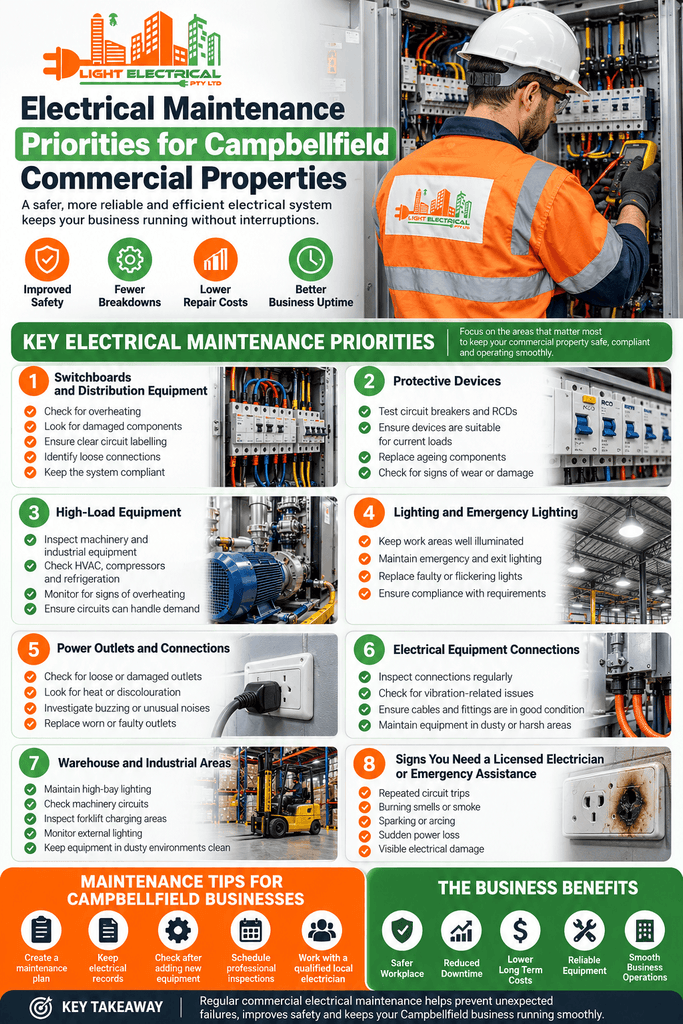
1. Switchboards and Distribution Equipment
The switchboard is one of the most important areas to inspect because it controls the distribution of electrical power throughout the premises.
Maintenance checks may identify:
Signs of overheating
Damaged components
Loose or deteriorated connections
Circuit identification problems
Ageing protective devices
Water or contamination exposure
Signs of arcing or burning
Unusual heat around breakers
Poorly arranged or modified wiring
One practical issue technicians often encounter is unclear circuit labelling. In a busy commercial property, a label such as “Warehouse” may not provide enough information when someone needs to isolate a specific circuit quickly.
Clear circuit identification can save valuable time during maintenance and emergencies.
2. Protective Devices
Circuit breakers and residual current devices are designed to provide protection when electrical conditions become unsafe.
However, simply having protective devices installed does not mean the system can be ignored.
During maintenance, an electrician can assess whether protective devices are appropriate for the installation and whether required testing or servicing is necessary.
This is particularly important where a property has undergone renovations, equipment changes or electrical alterations since the original installation.
3. High-Load Equipment
Commercial premises frequently contain equipment that places substantial demand on electrical circuits.
Examples include:
Commercial ovens
Industrial machinery
Compressors
Pumps
Large refrigeration systems
HVAC equipment
Workshop equipment
Battery charging systems
A circuit that was adequate when equipment was first installed may become problematic after additional loads are introduced.
If breakers repeatedly trip, equipment causes voltage-related issues, or cables and connections show signs of overheating, the issue should be investigated rather than repeatedly resetting the breaker.
Electrical Services That Should Be Monitored Regularly
A useful maintenance strategy considers the entire electrical environment rather than concentrating only on obvious faults.
Lighting and Emergency Lighting
Lighting failures may appear minor, but inadequate lighting can create operational and safety problems.
In warehouses and workshops, poor illumination can make it harder for employees to identify hazards, read equipment controls or move safely around work areas.
Emergency and exit lighting deserve particular attention because they are intended for situations where normal lighting may not be available.
Maintenance should include appropriate inspection and testing based on the installation and applicable requirements.
Power Outlets and Connection Points
Commercial outlets can experience considerable wear.
A socket may be used dozens or hundreds of times over its working life, particularly in workshops, kitchens, retail spaces and offices.
Warning signs include:
Loose-fitting plugs
Cracked outlets
Discolouration
Heat around a socket
Intermittent power
Buzzing or unusual noises
Burn marks
A damaged outlet should not simply be taped, tightened or left until the next convenient maintenance visit. The cause should be established because the outlet may be showing symptoms of a wider circuit problem.
Electrical Equipment Connections
Machinery connections deserve special attention because vibration, movement, heat and repeated operation can affect electrical components.
For example, a motor-driven machine in a Campbellfield workshop may operate for long periods every day. A connection that remains stable in a lightly used office environment may require different maintenance consideration in a high-use industrial setting.
Electrical Maintenance for Industrial and Warehouse Properties
Campbellfield has many commercial and industrial environments where electrical systems operate under demanding conditions.
Dust, vibration, temperature changes, moisture and heavy equipment can all influence electrical reliability.
A warehouse maintenance plan may therefore include checks of:
High-bay lighting
Warehouse power outlets
Distribution boards
Machinery circuits
Forklift or battery charging areas
External lighting
Emergency lighting
Switches and isolators
HVAC connections
Electrical equipment in dusty areas
One useful principle is to give greater maintenance attention to equipment exposed to harsher operating conditions.
A lighting circuit in a clean office may have very different maintenance requirements from equipment operating beside machinery in a dusty workshop.
Commercial Electrical Maintenance Campbellfield Should Be Risk-Based
Not every electrical component requires the same level of attention.
A practical maintenance program ranks equipment according to factors such as:
Likelihood of failure × consequence of failure
For example, a faulty decorative light may be inconvenient, while failure of the electrical supply to a refrigeration system could result in significant stock losses.
Similarly, an electrical problem affecting a critical production machine may interrupt an entire workflow.
This is where commercial electrical maintenance Campbellfield becomes more valuable than simply following a generic checklist.
High-Priority Assets
These may include:
Main switchboards
Critical production equipment
Refrigeration systems
Essential HVAC equipment
Emergency lighting
Fire and life-safety-related electrical systems
High-load machinery
Medium-Priority Assets
These could include:
General lighting
Standard power outlets
Office equipment circuits
Non-critical HVAC equipment
Lower-Priority Assets
These may include non-essential decorative lighting or equipment where failure has limited operational consequences.
The exact classification should be based on the property and its actual use.
Local Electrician Inspections Should Look for Early Warning Signs
One of the most valuable aspects of professional maintenance is identifying problems before they become obvious failures.
An experienced Local Electrician does not only ask, “Does it work?”
They also look for evidence that something may be deteriorating.
Heat
Excessive heat can indicate an overloaded circuit, poor connection, failing component or another electrical issue.
Thermal inspection methods can be useful in appropriate circumstances because some developing problems produce heat before visible damage appears.
Noise
Buzzing, crackling or unusual humming from electrical equipment should be investigated.
Not every electrical sound indicates an immediate emergency, but unusual changes should not be dismissed.
Smell
A persistent burnt-plastic or electrical odour is a warning sign.
If the smell is strong, accompanied by smoke, heat, sparking or other signs of danger, the area should be treated as an electrical safety issue rather than a routine maintenance request.
Repeated Circuit Trips
A breaker that trips once may have a straightforward explanation.
A breaker that repeatedly trips is different.
Repeated tripping can indicate:
Overloading
Faulty equipment
Wiring problems
Short circuits
Earth leakage
A deteriorating component
Repeatedly resetting the breaker without investigating the cause is a poor maintenance strategy.
When to Call a Licensed Electrician Campbellfield VIC
Electrical work should be performed by appropriately licensed professionals and in accordance with applicable Victorian requirements.
A licensed electrician Campbellfield VIC can assess electrical faults, carry out permitted electrical work and provide advice appropriate to the installation.
Professional assistance is particularly important when dealing with:
Switchboard faults
New circuits
Electrical modifications
Machinery connections
Persistent circuit trips
Damaged wiring
Electrical burning smells
Power failures affecting equipment
Testing and maintenance requirements
Major electrical upgrades
Commercial properties should also maintain records of relevant electrical work, inspections, testing and repairs where required.
Good documentation helps the next technician understand what has changed and makes it easier for property managers to identify recurring problems.
Emergency Electrical Problems Need a Different Response
Routine maintenance and emergency response should not be treated as the same activity.
An emergency electrician Campbellfield may be required when an electrical problem presents an immediate safety risk or causes a significant operational failure.
Potential warning signs include:
Smoke from electrical equipment
Sparking or arcing
Burning electrical smells
Exposed live electrical components
Significant electrical damage
Sudden loss of power accompanied by unusual electrical symptoms
Dangerous damage following an incident
If there is immediate danger, people should stay clear of the affected area and follow the property’s emergency procedures. Electrical equipment should not be opened or repaired by unqualified personnel.
The best emergency strategy, however, is prevention.
Regular maintenance can reduce the likelihood that a deteriorating connection, overloaded circuit or ageing component becomes a major after-hours failure.
A Practical Commercial Electrical Maintenance Schedule
There is no single maintenance interval suitable for every commercial property. Frequency should depend on the installation, equipment, environment, usage and relevant requirements.
A useful maintenance framework can still be organised into three levels.
Routine Visual Checks
Property or facility teams can watch for obvious warning signs such as:
Damaged outlets
Broken switches
Flickering lights
Repeated breaker trips
Unusual smells
Damaged electrical equipment
Exposed cables
Water near electrical equipment
These checks are not a substitute for electrical testing, but they can help identify problems earlier.
Planned Professional Maintenance
A qualified electrician can assess the installation at appropriate intervals, considering the property’s risk profile.
This may involve:
Switchboard assessment
Protective-device testing where applicable
Inspection of connections
Lighting checks
Machinery circuits
Emergency lighting
Electrical equipment
Visible wiring and accessories
The frequency should be determined according to the specific property rather than choosing an arbitrary calendar date.
Immediate Investigation
Certain issues should not wait for a scheduled visit.
Examples include:
Burning smells
Visible electrical damage
Persistent tripping
Sparking
Exposed conductors
Significant overheating
Sudden unexplained equipment failures
Common Commercial Electrical Maintenance Mistakes
Waiting Until Something Fails
Reactive maintenance can be expensive because electrical failures rarely affect only the faulty component.
A failed circuit may stop machinery. A failed refrigeration circuit may affect stock. A lighting problem may disrupt warehouse operations.
Preventive maintenance gives businesses a chance to address developing problems during planned downtime.
Repeatedly Resetting Breakers
A breaker is not an inconvenience designed to be reset indefinitely.
If it trips repeatedly, the underlying cause needs investigation.
Adding Equipment Without Reviewing Capacity
Businesses often grow incrementally.
One machine becomes two. A new refrigerator is added. Additional computers are installed. A workshop receives new equipment.
Each individual addition may appear reasonable, but the combined electrical demand can change the system’s operating conditions.
Ignoring Small Warning Signs
A flickering light may seem unimportant.
A warm outlet may appear to be a minor issue.
A breaker that trips every few weeks may be tolerated.
These symptoms can provide useful information about developing electrical problems. Recording and investigating recurring issues is far more useful than treating each event as an isolated inconvenience.
How to Build a Better Maintenance Strategy
A strong commercial maintenance plan should be practical enough for a business to follow.
Step 1: Identify Critical Electrical Assets
List equipment where failure would create major safety, operational or financial consequences.
Step 2: Record Known Problems
Keep a simple maintenance log.
Record:
Date
Location
Equipment
Fault observed
Action taken
Follow-up required
Patterns often become obvious when faults are recorded over time.
Step 3: Consider the Environment
A clean office, food premises, warehouse and industrial workshop do not have identical electrical risks.
Consider exposure to:
Dust
Moisture
Heat
Chemicals
Vibration
Heavy machinery
Outdoor conditions
Step 4: Plan Maintenance Around Operations
Where possible, schedule non-urgent electrical work during suitable periods to reduce disruption.
For a production business, a short planned shutdown may be preferable to an unexpected failure during peak production.
Step 5: Review Changes to the Property
Whenever a business adds machinery, renovates an area or changes how a space is used, review whether the existing electrical installation remains suitable.
This is one of the most commonly overlooked parts of ongoing electrical maintenance.
Expert Tips for Campbellfield Commercial Property Managers
Do not judge electrical health by whether everything currently works. Electrical systems can deteriorate while remaining operational.
Pay attention to recurring faults. Three similar failures over six months may reveal a pattern that one isolated repair would hide.
Prioritise critical equipment. Not every circuit presents the same business risk.
Keep electrical records organised. Good documentation improves maintenance decisions and reduces unnecessary diagnostic time.
Investigate modifications. New machinery or additional loads can change the demands placed on existing infrastructure.
Never rely on unqualified electrical repairs. Commercial environments can involve higher loads and more complex systems than typical residential installations.
Treat heat, burning smells and sparking seriously. These are not cosmetic maintenance issues.
Conclusion
Electrical maintenance is easiest to appreciate after something goes wrong—but that is exactly when it becomes most expensive and disruptive.
For Campbellfield commercial properties, the smarter approach is to understand which electrical assets matter most, identify early warning signs, monitor changes in electrical demand and schedule appropriate professional inspections.
The goal of commercial electrical maintenance Campbellfield is not simply to keep switches and equipment operational. It is to create a safer, more predictable electrical environment that supports the way the business actually operates.
Whether the property is a warehouse, workshop, retail premises, office or mixed-use commercial facility, maintenance priorities should be based on real operating conditions and risk.
A commercial electrician Campbellfield can help assess those priorities and identify areas that deserve attention before a minor electrical issue becomes a major business interruption.
FAQ
1. How often should commercial electrical maintenance be performed in Campbellfield?
There is no universal interval that applies to every commercial property. The appropriate frequency depends on the type of installation, equipment, operating environment, electrical load, age of the system and relevant regulatory or manufacturer requirements.
A warehouse with heavy machinery may require a different maintenance approach from a small office. Properties with dusty, hot, damp or high-vibration environments may also require closer attention.
The most effective approach is to develop a documented maintenance schedule based on the property’s actual risks rather than relying solely on a generic annual checklist.
2. What are the warning signs that a commercial electrical system needs attention?
Common warning signs include repeated circuit trips, flickering lights, warm outlets, unusual buzzing, burning smells, discoloured electrical components, unexplained equipment failures and damaged cables or accessories.
The important point is to look for patterns.
For example, if the same circuit trips whenever a particular machine starts, the problem may involve the equipment, circuit capacity or another electrical fault. Simply resetting the breaker does not resolve the underlying issue.
3. Can adding new commercial equipment overload an existing electrical system?
Yes. Adding equipment can increase electrical demand, particularly where machinery, heating, cooling, refrigeration or other high-load devices are involved.
The issue is not necessarily whether one new appliance is “large.” Several smaller additions can collectively increase the demand on existing circuits.
Before significant equipment is installed, the electrical requirements should be assessed by a suitably qualified professional to determine whether existing circuits and infrastructure are appropriate.
4. What should a Campbellfield business do if a circuit keeps tripping?
Repeated tripping should be investigated rather than continually resetting the breaker.
Possible causes include an overloaded circuit, faulty equipment, wiring faults, short circuits or earth leakage.
If there are accompanying signs such as burning smells, smoke, sparking or excessive heat, the situation should be treated as more urgent. Staff should not attempt to dismantle electrical equipment or access electrical components themselves.
A qualified electrician can investigate the cause and determine the appropriate repair.
5. Is preventive commercial electrical maintenance really worth it?
For many businesses, the value is not simply avoiding an electrical repair bill. Preventive maintenance can reduce unexpected downtime, identify developing faults, support safer operation and provide better visibility over the condition of important electrical assets.
Consider a business where one failed circuit stops a critical machine. The cost may include technician call-out charges, replacement components and lost production time. Planned maintenance cannot eliminate every electrical failure, but it can help businesses identify and address many problems before they develop into disruptive events.
At Light Electricians Pty Ltd., we care about our clients and helping them get peace of mind knowing that your electricians system is working properly. Our technicians are licensed, trained, and skilled to handle any electricians project, no matter how big or small. Our electricians design, install, service, and repair electricians systems and parts in strict accordance with the highest industry standards. Our team knows you’re busy, and your time is valuable.
Contact Light Electricians Pty Ltd. today to get a competitive quote for the best brand of safety switches and switchboard upgrades, whether you want to do a major upgrade or need to replace all your circuit breakers with safety switches. We are committed to absolute professionalism and take great pride in our customers' satisfaction. Don't wait to get your switchboard upgraded contact us today.