Buying a new refrigerator, electric oven, induction cooktop, washing machine or air conditioner can make everyday life more convenient. However, before connecting a new appliance, it is important to check whether your home’s electrical system can safely support its requirements.
Many homeowners assume that if an appliance fits into the available space and its plug fits an existing outlet, it is ready to use. In reality, some appliances require dedicated circuits, specific connection arrangements or additional electrical capacity. An ageing switchboard, damaged outlet or overloaded circuit can also create problems that may not be immediately obvious.
For homeowners in Dallas, Victoria, preparing ahead can help prevent installation delays, identify electrical concerns and reduce the risk of avoidable faults.
A residential electrician Dallas homeowners consult can assess the existing installation, explain the electrical requirements of new appliances and identify whether any changes are necessary. Light Electrical can be considered when planning electrical work for your home, with any recommendations based on the actual requirements of the property.
This guide explains how to prepare your electrical system, recognise when upgrades may be needed and plan a safer appliance installation.
Why Electrical Preparation Matters Before Installing New Appliances
Modern appliances are designed to make household tasks easier, but their electrical requirements can differ considerably.
A small microwave may operate on a suitable existing circuit, while an electric oven, induction cooktop or large air conditioner may require a dedicated circuit or a different connection arrangement.
The important point is that an appliance’s suitability depends on more than its physical size or plug type. Its rated power, starting current, installation instructions and the capacity of the existing circuit all need consideration.
For example, imagine replacing an older electric oven with a newer model. The new oven might have different electrical requirements from the previous one. If this is discovered on delivery day, installation may need to be postponed until the appropriate electrical work is completed.
Preparing in advance helps homeowners:
Identify electrical limitations before purchasing an appliance.
Determine whether a dedicated circuit or new outlet is necessary.
Check whether the existing switchboard is suitable for the proposed load.
Address existing electrical faults before introducing additional demand.
Coordinate electrical work with kitchen or laundry renovations.
Reduce the likelihood of unexpected installation delays.
Electrical Preparation for Dallas Homes should begin before the appliance arrives, particularly when installing high-powered equipment or replacing appliances in an older property.
1. Residential Electrician: Assess Your Existing Electrical System
Before purchasing a major appliance, review the electrical arrangements in the room where it will be installed. Basic observations can help you identify questions to discuss with a professional, although they cannot replace an electrical inspection.
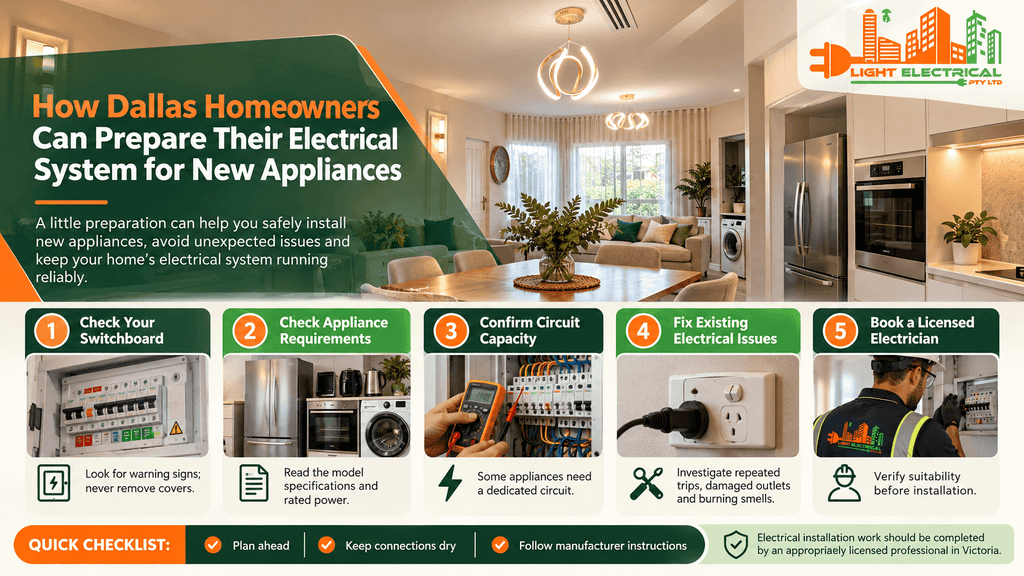
Check the condition of your switchboard
Your switchboard distributes electricity to different circuits throughout your home. It also contains protective devices designed to disconnect power under certain fault conditions.
An older switchboard is not automatically unsafe. However, damaged components, unusual buzzing, burning smells, signs of overheating or repeated circuit interruptions should not be ignored.
If you are planning to install several large appliances, ask whether your existing switchboard and protective devices are suitable for the additional load.
A qualified electrician can assess:
The capacity of the electrical supply.
The arrangement and condition of existing circuits.
The suitability of circuit breakers and safety switches.
Whether the proposed appliances need dedicated circuits.
Whether a switchboard upgrade is necessary.
Avoid removing switchboard covers or attempting to inspect internal wiring yourself.
Identify the circuits serving your appliances
Kitchen and laundry areas often contain several appliances that may operate simultaneously. A kettle, microwave, dishwasher and toaster, for example, can create a considerable combined load if they share a circuit.
Check the existing circuit labels and note which appliances are connected to each area. Remember that labels may be inaccurate, particularly in older homes or properties that have undergone several renovations.
A licensed electrician can verify the circuit arrangement and determine whether the proposed appliance can be connected safely.
Look for warning signs around outlets
Before using an existing outlet, look for visible damage, discolouration, loose faceplates or signs of overheating.
Do not use damaged outlets or attempt to repair them yourself. If you notice burning smells, smoke or sparking, keep clear of the affected equipment and seek urgent assistance. Contact emergency services if there is a fire or immediate danger.
These warning signs should be investigated before connecting new equipment.
2. Electrical Upgrades: Understand Your New Appliance’s Power Requirements
One of the most important preparation steps is understanding how much electrical power your new appliance needs.
Manufacturers provide electrical information on product labels, technical specifications and installation manuals. Depending on the appliance, this information may include voltage, current, rated power and connection requirements.
Never assume that two appliances of a similar size have identical electrical needs.
Understand watts, amps and circuit capacity
Electrical power is measured in watts (W) or kilowatts (kW), while electrical current is measured in amperes (A).
For example, an appliance rated at 2,400 watts operating at approximately 240 volts draws around 10 amps under those conditions.
However, this calculation alone does not establish whether an existing circuit is suitable. Other connected appliances, cable ratings, installation conditions and manufacturer requirements must also be considered.
A qualified electrician can determine whether the circuit has sufficient capacity and whether the appliance needs a dedicated supply.
Which appliances may need dedicated circuits?
Different appliances have different installation requirements.
Appliance
Important electrical considerations
Electric oven
Rated load, circuit capacity and connection method
Induction cooktop
Power requirements and dedicated circuit suitability
Dishwasher
Manufacturer’s instructions, outlet location and circuit loading
Washing machine
Outlet condition, electrical load and proximity to water
Clothes dryer
Rated power and connection requirements
Air conditioner
Starting current, circuit capacity and isolation arrangements
Electric vehicle charger
Available supply capacity and dedicated installation requirements
Heat-pump water heater
Rated load and manufacturer-specified installation arrangements
These are general considerations, not universal wiring specifications. Requirements vary by model and installation.
For instance, replacing a small appliance may not require electrical changes if the existing installation is suitable. Installing a new induction cooktop may require a different circuit or connection arrangement.
The correct decision should be based on the manufacturer’s documentation and a professional assessment.
Plan for future appliances
If you are renovating your kitchen or laundry, consider which appliances you might add over the next few years.
You may currently need a new oven but later plan to install an induction cooktop, a larger dishwasher or additional air conditioning.
Discussing these plans during an initial electrical assessment may help you coordinate work efficiently. It does not mean every possible upgrade needs to happen immediately. Instead, the electrician can explain which improvements are necessary now and which can reasonably wait.
3. Electrical Safety: Protect Your Home Before Connecting New Equipment
Electrical safety should be part of every appliance installation, not an afterthought.
Even a brand-new appliance can create risks if it is connected to damaged wiring, an unsuitable circuit or a poorly maintained outlet.
Check safety switches and circuit protection
Safety switches, also known as residual current devices (RCDs), are designed to disconnect electricity quickly when they detect certain leakage currents. They help reduce the risk of electric shock.
Circuit breakers serve a different purpose by protecting circuits against conditions such as overloads and short circuits.
When preparing for new appliances, ask an appropriately licensed electrician to check whether the relevant protective devices are suitable for the installation and comply with applicable requirements.
Do not assume that every electrical hazard is eliminated simply because your switchboard contains safety switches.
Keep electrical connections away from water
Kitchens and laundries combine electrical equipment with water, making appropriate installation especially important.
Before installing a washing machine or dishwasher, consider:
Whether the outlet is appropriately positioned.
Whether the plug and connection can remain protected from leaks.
Whether hoses and drainage connections are correctly arranged.
Whether the power cord can remain free from crushing or damage.
Whether the manufacturer’s instructions specify additional precautions.
Avoid using extension leads as a permanent substitute for suitable outlets. Do not place plugs or electrical connections where they could become exposed to water.
If water reaches an electrical outlet or appliance connection, do not touch the wet equipment. Keep clear and obtain professional assistance.
Never ignore repeated circuit trips
A circuit breaker that trips repeatedly may indicate an overloaded circuit, a faulty appliance, damaged wiring or another electrical problem.
Resetting it repeatedly does not resolve the underlying cause.
If a new appliance causes a circuit to trip, stop using it and arrange an assessment. If you also notice smoke, burning smells or sparking, treat the situation as urgent.
An electrician can investigate whether the issue originates from the appliance, its circuit or the broader electrical installation.
4. Prepare the Installation Area Before Delivery Day
Electrical preparation is not limited to the switchboard. The physical layout of the room can also affect how safely an appliance is installed.
Measure the available space
Check the appliance’s dimensions, including any clearance required around its sides, rear and top. Built-in appliances may have specific cabinet and ventilation requirements.
Confirm that the intended location allows the appliance to be installed without pinching its power cord or putting pressure on the electrical connection.
If you are replacing an older appliance, do not assume that the existing opening will automatically suit the new model.
Check the location of the power connection
Identify the position of the existing outlet or connection point before moving cabinets or appliances.
A new refrigerator may need more space behind it because of its dimensions or ventilation requirements. A built-in oven may have a different connection position from the previous model.
If the connection point becomes inaccessible or the cord cannot reach safely, consult an electrician before installation. Do not stretch, splice or modify appliance cables to make them fit.
Coordinate electrical work with other trades
Kitchen and laundry projects may involve cabinetmakers, plumbers, electricians and appliance installers.
Electrical work is often easier to coordinate before cabinetry is finalised, splashbacks are installed or appliances are fitted into tight spaces.
For example, if a new cooktop requires a different electrical connection, arranging an assessment before the benchtop installation can help avoid rework.
Confirm who is responsible for each part of the installation. An appliance retailer’s delivery service may not include new circuits, switchboard upgrades or alterations to fixed wiring.
5. Electrical Repairs: Address Existing Problems Before Adding More Load
A new appliance should not be used to test whether an existing electrical problem has disappeared.
If your home already experiences flickering lights, unexplained power interruptions or damaged outlets, have these concerns investigated before increasing electrical demand.
Recognise common electrical warning signs
Not every electrical symptom has the same cause. Avoid diagnosing a fault based on appearance alone.
Common warning signs include:
Flickering lights: These may result from a loose lamp, an appliance starting up or a more serious wiring or supply issue.
Repeated circuit trips: These may indicate excessive load, a faulty appliance or a circuit fault.
Warm or discoloured outlets: These can indicate a potentially dangerous connection problem.
Buzzing or crackling sounds: These should be investigated, particularly when coming from a switchboard, outlet or fixed wiring.
Burning smells: Stop using the affected equipment and seek urgent professional assistance.
Do not open outlets, remove switchboard covers or attempt to tighten electrical connections yourself.
When to arrange electrical repairs Dallas homeowners may need
Arranging professional electrical repairs Dallas homeowners need before installing new appliances can help identify and address existing faults before additional electrical demand is introduced.
For example, a homeowner who notices a circuit breaker tripping whenever the kettle and microwave operate together should not simply connect another high-powered appliance and hope the problem disappears.
An appropriately licensed electrician can investigate whether the issue involves circuit loading, a defective appliance, damaged wiring or another electrical fault. The recommended repair should address the underlying cause rather than just the visible symptom.
The same principle applies to damaged outlets, flickering lights and unusual electrical noises. Having these concerns investigated before an appliance upgrade can help establish whether the installation is suitable for its intended use.
Consider the needs of older homes
Older properties may have undergone several renovations. Some have updated wiring and switchboards, while others may retain circuits designed around earlier household demands.
The property’s age alone does not prove that its electrical installation is unsafe. What matters is the condition of the wiring, the suitability of the circuits and the effectiveness of the installed protective devices.
A professional inspection can establish what work, if any, is necessary.
6. How to Choose the Best Residential Electrician in Dallas
Choosing an electrician is an important part of preparing your home for new appliances. The right professional should be able to assess the existing installation, explain technical requirements and recommend work based on genuine safety or capacity needs.
Verify the electrician’s licence and qualifications
In Victoria, electrical installation work is subject to licensing, registration and safety requirements. Electrical contractors must also meet the applicable requirements for the contracting work they undertake.
Before engaging a contractor, check their credentials through Energy Safe Victoria (ESV), the state’s electrical safety regulator.
You can visit Energy Safe Victoria for information about electrical licensing, safety requirements and certificates of electrical safety.
This is particularly important when a job involves fixed wiring, a new circuit, switchboard alterations or an appliance connection that requires electrical installation work.
Why a licensed electrician Dallas VIC homeowners consult matters
When choosing a licensed electrician Dallas VIC homeowners can rely on, focus on relevant credentials, experience with residential electrical installations and the ability to explain the proposed work clearly.
Before installing a major appliance, a qualified professional can assess circuit capacity, inspect relevant safety devices and determine whether the existing electrical arrangement is suitable. They can also explain whether additional electrical work is necessary.
Verify the electrician’s credentials and confirm that the proposed work complies with applicable Victorian electrical safety requirements.
Ask for a clear explanation of the proposed work
A professional assessment should help you understand what your home needs and why.
Useful questions include:
Is the existing circuit suitable for the new appliance?
Does the appliance require a dedicated circuit?
Is the current switchboard appropriate for the proposed load?
Are there any existing safety concerns?
Which changes are essential, and which are optional improvements?
What work is included in the quote?
Will the required electrical documentation be provided?
These questions help homeowners compare quotes on a like-for-like basis.
Look for practical advice rather than unnecessary upgrades
The best solution is not always the most expensive one.
An existing circuit may be suitable for a particular appliance, while another installation may require a new circuit or additional protection. The recommendation should depend on the actual conditions and the appliance’s requirements.
The best residential electrician in Dallas is one who assesses the installation, explains the available options and recommends work appropriate to your home.
Be cautious of blanket recommendations made without checking the appliance specifications or existing installation. Equally, a low quote that excludes essential safety work may not represent good value.
How Light Electrical fits into your preparation
Light Electrical can be considered when planning electrical work before new household appliances are installed.
A useful starting point is to explain which appliance you intend to install, whether it is replacing an existing model and whether you have noticed any electrical problems.
Providing this information helps clarify the scope of the assessment. Any recommendation for repairs or upgrades should follow from the conditions found at the property and the manufacturer’s requirements.
7. Electrical Preparation for Dallas Homes: A Practical Checklist
Use this checklist before arranging appliance delivery or installation.
Identify the exact appliance model and read its installation manual.
Confirm its rated power and connection requirements.
Check the existing outlet for visible damage without dismantling it.
Note recurring circuit trips, flickering lights or unusual electrical smells.
Confirm the appliance’s dimensions and ventilation clearances.
Ask whether the existing circuit and switchboard are suitable.
Arrange required electrical work before delivery day.
Confirm who is responsible for the electrical connection and appliance installation.
Keep the appliance manual and relevant electrical documentation.
Operate the appliance according to the manufacturer’s instructions.
Completing this checklist does not certify that an installation is electrically safe. It helps you prepare for a more informed discussion with a qualified professional.
8. Common Mistakes to Avoid When Installing New Appliances
Even well-intentioned homeowners can overlook important details when replacing electrical equipment.
Assuming the old appliance proves the circuit is suitable
A replacement appliance may have different power requirements from the one it replaces. Always check the new model’s specifications rather than assuming the existing circuit is appropriate.
Using extension leads as a permanent solution
An extension lead may be unsuitable for a high-powered appliance or its installation environment. Follow the manufacturer’s instructions and arrange a suitable outlet where necessary.
Ignoring the combined electrical load
A home may operate each appliance without an obvious problem when they are used separately. Running several high-demand appliances together can reveal limitations in the existing installation.
An electrician can assess the actual circuit arrangement and broader supply requirements.
Waiting until installation day
Discovering that a new appliance needs a circuit upgrade after delivery can delay the project and create additional costs.
Check the requirements before finalising installation arrangements, particularly for ovens, cooktops, air conditioners and other high-powered equipment.
Attempting DIY electrical modifications
Electrical installation work in Victoria is subject to licensing and safety requirements. Do not modify fixed wiring, install circuits or undertake switchboard work unless you are legally authorised and appropriately qualified.
Leaving this work to an appropriately licensed professional helps protect household occupants and the integrity of the electrical installation.
9. Expert Tips for a Smoother Appliance Upgrade
A little forward planning can make appliance upgrades easier and help avoid unnecessary electrical work.
Compare electrical requirements before buying. If you are choosing between appliance models, compare their rated power and installation requirements alongside their price, dimensions and energy efficiency.
Keep appliance specifications available. Saving the model number, rated power and installation instructions makes it easier to discuss requirements with your electrician.
Coordinate related work. If a kitchen renovation already requires a new circuit, discuss other planned electrical work during the same assessment. Coordinating tasks may reduce disruption, although actual savings depend on the property and work involved.
Do not confuse energy efficiency with circuit suitability. An energy-efficient appliance may reduce electricity consumption over time, but this does not automatically mean that its electrical connection requirements are lower.
Keep records of completed work. Retain relevant invoices, certificates of electrical safety where required, appliance manuals and installation documentation. These records can help with future maintenance and troubleshooting.
Most importantly, ask questions if you do not understand a recommendation. A competent professional should be able to explain the reason for the proposed work in clear, practical language.
Conclusion: Prepare Your Electrical System Before Your Next Appliance Upgrade
New appliances can improve comfort, convenience and everyday efficiency, but they should always be compatible with your home’s electrical installation.
Start by checking the manufacturer’s requirements, reviewing the installation area and identifying existing electrical concerns. Before installing high-powered appliances or making changes to fixed wiring, have the circuit capacity, switchboard and required safety protection assessed by an appropriately licensed professional.
For residential electrician Dallas homeowners, early preparation can help prevent installation delays, identify potential hazards and make future electrical improvements easier to plan.
Light Electrical can be considered as part of that process when you need guidance on preparing your home’s electrical system for new appliances. Whether you are replacing an oven, upgrading your laundry or planning several household improvements, the priority should be a safe, suitable installation supported by professional advice.
Frequently Asked Questions
1. Do I need a residential electrician in Dallas before installing a new appliance?
Not every appliance replacement requires electrical work. A small appliance connected to a suitable, undamaged existing outlet may not need an electrician.
However, a professional assessment is advisable when installing high-powered appliances, adding a circuit, changing fixed wiring or replacing equipment with different electrical requirements.
An electrician should also investigate existing warning signs, such as repeated circuit trips, damaged outlets or burning smells, before the affected equipment is used.
The manufacturer’s instructions and the condition of your existing installation should determine the next steps.
2. How do I know whether my switchboard can support new appliances?
You cannot reliably determine switchboard capacity by looking at its appearance or counting unused circuit-breaker spaces.
A licensed electrician can assess the electrical supply, existing circuits, protective devices and anticipated load. They can then determine whether the proposed appliance can be accommodated or whether additional work is necessary.
A switchboard replacement is not automatically required whenever a new appliance is installed. The recommendation should be based on the actual installation and applicable safety requirements.
3. Can I use the existing power outlet for a new electric oven or cooktop?
Possibly, but it depends on the appliance’s rated load, connection requirements and the suitability of the existing circuit.
Some appliances require a dedicated circuit or a specific connection arrangement. Others may be suitable for an existing circuit if it meets the manufacturer’s instructions and applicable electrical requirements.
Do not change plugs, adaptors or wiring simply to make the new appliance fit an existing connection. Have an appropriately qualified electrician verify the arrangement before connecting equipment that requires electrical installation work.
4. What should I do if my circuit breaker trips after installing a new appliance?
Stop using the appliance and arrange an assessment by an appropriately licensed electrician. The cause could be an overloaded circuit, a faulty appliance, damaged wiring or another electrical fault.
Avoid repeatedly resetting the breaker, bypassing protective devices or connecting the appliance to another circuit without establishing the cause.
If you notice smoke, sparking or a burning smell, keep clear of the affected equipment and seek urgent assistance. Contact emergency services if there is a fire or immediate danger.
5. How can I choose the best residential electrician in Dallas for appliance preparation?
Start by verifying the electrician’s credentials through Energy Safe Victoria. Explain which appliances you intend to install, provide their model numbers and mention any existing electrical concerns.
Ask for a clear explanation of the inspection findings, the work recommended, the costs involved and any required electrical documentation. Compare quotes based on their scope rather than price alone.
For homeowners considering Light Electrical, a discussion about the proposed appliance installation and any electrical changes that may be needed is a sensible starting point. This helps ensure that recommendations are relevant to the property rather than based on assumptions.
At Light Electricians Pty Ltd., we care about our clients and helping them get peace of mind knowing that your electricians system is working properly. Our technicians are licensed, trained, and skilled to handle any electricians project, no matter how big or small. Our electricians design, install, service, and repair electricians systems and parts in strict accordance with the highest industry standards. Our team knows you’re busy, and your time is valuable.
Contact Light Electricians Pty Ltd. today to get a competitive quote for the best brand of safety switches and switchboard upgrades, whether you want to do a major upgrade or need to replace all your circuit breakers with safety switches. We are committed to absolute professionalism and take great pride in our customers' satisfaction. Don't wait to get your switchboard upgraded contact us today.