Electrical problems rarely happen at a convenient time. A power point may suddenly stop working, lights might begin flickering, or a safety switch could trip repeatedly without an obvious reason. While some faults appear minor, they can sometimes indicate a deeper problem with your home’s electrical system.
For Reservoir homeowners, understanding what causes these issues and what to check before arranging repairs can make a significant difference. Acting early can help prevent further damage, reduce potential safety risks and make it easier for an electrician to identify the actual problem.
Booking electrical repairs Reservoir homeowners can rely on is not simply about getting the power working again. It is about understanding why the fault occurred, whether other parts of the electrical system are affected and what needs to be done to restore safe operation.
At Light Electrical, the focus is on helping homeowners make informed decisions about their electrical needs. Knowing what to expect from Professional electrical services Reservoir residents may require can help you approach an electrical repair with greater confidence.
This guide explains the common warning signs, the importance of professional fault finding, what to ask before booking an electrician and how to prepare your property for an electrical inspection.
Why Electrical Problems Should Never Be Ignored
Most homeowners depend on electricity throughout the day. Lighting, kitchen appliances, heating and cooling systems, computers and entertainment equipment all rely on a safe and properly functioning electrical installation.
When something goes wrong, it is tempting to look for a quick solution. However, repeatedly resetting a circuit breaker or ignoring an unusual electrical smell does not resolve the underlying issue.
Electrical faults can develop for several reasons, including:
- Ageing or damaged electrical wiring.
- Overloaded electrical circuits.
- Loose electrical connections.
- Faulty switches and power points.
- Damaged household appliances.
- Moisture entering electrical fittings.
- Worn electrical components.
- Problems with switchboards or circuit protection.
For example, imagine that the power in your kitchen suddenly stops working whenever you use the kettle and microwave together. You might assume that one appliance is faulty. However, the problem could involve the circuit, its electrical load or a damaged connection.
Without proper testing, it is difficult to identify the actual cause.
This is why electrical faults should be investigated rather than treated as isolated inconveniences. A qualified professional can assess the affected circuit, identify possible contributing factors and recommend an appropriate repair.
Electrical Repairs: Warning Signs Reservoir Homeowners Should Recognise
Electrical problems do not always begin with a complete power failure. In many cases, the warning signs appear gradually.
Recognising these early symptoms can help you arrange an inspection before the problem becomes more serious.
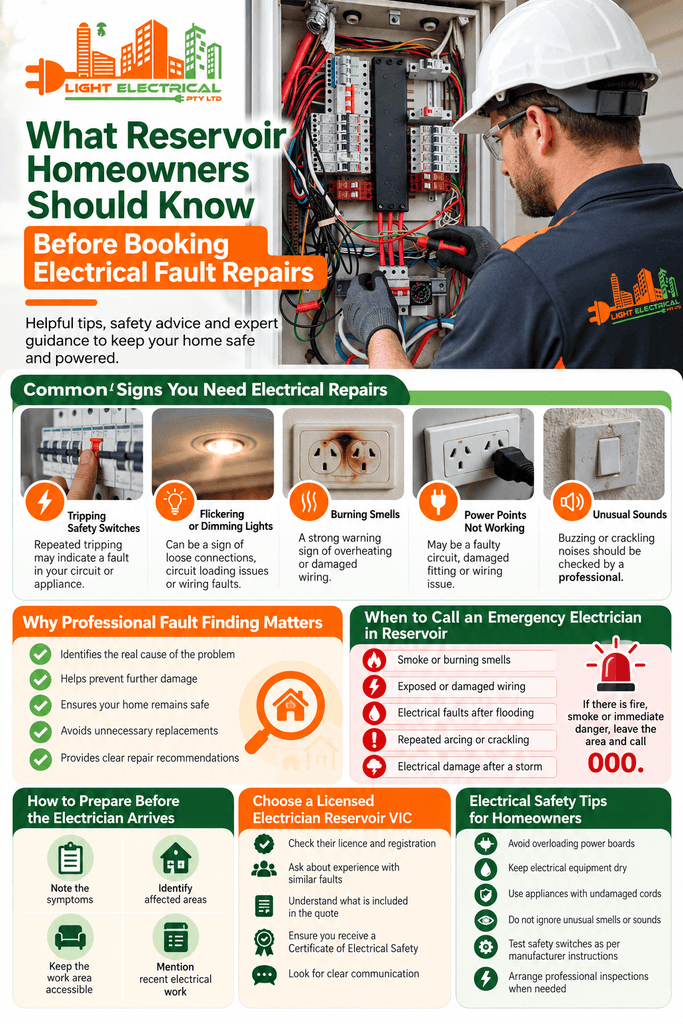
1. Frequently Tripping Safety Switches
A safety switch that repeatedly trips is one of the most common reasons homeowners seek electrical assistance.
Safety switches are designed to disconnect electricity when they detect certain electrical leakage conditions. Their purpose is to reduce the risk of electric shock.
Repeated tripping may indicate:
- A faulty appliance.
- Damaged wiring.
- Moisture affecting electrical equipment.
- An insulation problem.
- An electrical circuit fault.
For example, if your safety switch trips whenever you use a particular washing machine, the appliance may be contributing to the issue.
However, the cause should be confirmed through appropriate testing. Do not repeatedly reset a safety switch that continues to trip.
2. Flickering or Dimming Lights
Occasional changes in lighting can happen for different reasons, but persistent flickering deserves attention.
Possible causes include:
- Loose electrical connections.
- Faulty light fittings.
- Problems with switches or dimmers.
- Circuit loading issues.
- Voltage supply problems.
Pay attention to when the flickering happens. Does it occur when an air conditioner starts? Does it affect one room or several areas of the property?
This information can help an electrician understand the pattern.
If several lights become unusually dim or flicker across the property, particularly alongside other electrical symptoms, contact your electricity distributor. Avoid touching the switchboard or metal fittings if you suspect a supply problem.
3. Burning Smells Around Power Points
A burning or melting-plastic smell near a power point, switch or electrical fitting should never be ignored.
It may indicate overheating, damaged insulation or an electrical connection problem.
Other warning signs include:
- Discoloured power point covers.
- Scorch marks around switches.
- Unusual buzzing sounds.
- Warm or hot electrical fittings.
- Visible damage to electrical accessories.
Stop using the affected fitting if it is safe to do so. Do not touch or dismantle it. If there is smoke or fire, move away and call emergency services on 000.
4. Power Points or Switches That Stop Working
A power point that suddenly stops working may have a simple explanation, such as a tripped circuit. However, it could also indicate a wiring fault or damaged electrical component.
Before booking a repair, note whether:
- Other power points in the same room are working.
- The problem affects one circuit or several.
- The issue started after using a particular appliance.
- There are visible signs of damage.
Avoid opening the power point or attempting to repair its internal wiring yourself.
5. Unusual Electrical Sounds
Buzzing, crackling or popping noises coming from electrical fittings should be investigated.
A quiet electrical system should not produce persistent unusual sounds from switches, outlets or the switchboard.
These noises may be associated with loose connections, damaged components or electrical arcing. They should not be treated as normal household sounds.
Understanding Fault Finding Before Booking a Repair
One important thing homeowners should understand is that repairing an electrical fault involves more than replacing the component that appears to be damaged.
Professional fault finding is the process of identifying the underlying cause of an electrical problem before deciding on the appropriate repair.
For example, replacing a power point may not solve an issue if the actual problem is a damaged cable behind the wall.
A proper investigation generally involves several stages.
Step 1: Understanding the Symptoms
The electrician first needs to understand what is happening.
Homeowners should explain:
- When the electrical problem started.
- Which rooms or areas are affected.
- Whether the issue happens continuously or occasionally.
- Whether a circuit breaker or safety switch has tripped.
- Whether any new appliances have recently been installed.
- Whether there has been water exposure, storm damage or renovation work.
These details help narrow down the possible causes.
Step 2: Inspecting the Affected Electrical Components
Depending on the reported symptoms, the electrician may inspect the relevant power points, switches, light fittings, switchboard and accessible wiring.
The inspection helps identify visible damage, deterioration or other signs that may explain the fault.
Step 3: Carrying Out Appropriate Electrical Tests
Visual inspections alone may not be enough.
An electrician may use suitable testing equipment to investigate circuit continuity, insulation resistance, voltage conditions and other electrical characteristics.
The tests selected depend on the type of fault and the electrical installation.
Step 4: Explaining the Findings
Once the investigation is complete, homeowners should receive a clear explanation of:
- What caused the fault, if identified.
- Which components are affected.
- Whether there are additional safety concerns.
- What repair work is recommended.
- Whether further investigation is necessary.
This step is important because it allows homeowners to understand what they are paying for rather than agreeing to an unexplained repair.
Emergency Electrician: When Should You Arrange Urgent Help?
Not every electrical issue requires an emergency response. However, some warning signs indicate an immediate safety concern.
Knowing the difference helps homeowners respond appropriately.
Consider contacting an emergency electrician Reservoir residents can access when an electrical fault creates an immediate risk, such as:
- Smoke coming from a power point or switchboard.
- Burning smells accompanied by signs of overheating.
- Exposed or visibly damaged electrical wiring.
- Electrical equipment affected by flooding or significant water damage.
- Repeated electrical arcing or crackling.
- A suspected electrical fault following storm damage.
If there is an active fire, smoke or immediate danger to people, leave the affected area and call 000.
Important: Do not touch exposed wires, damaged switchboards or water-affected electrical equipment. Keep children and other household members away from the affected area.
What If Your Entire Home Loses Power?
A complete power outage does not automatically mean there is a fault inside your home.
The problem could be related to the electricity distribution network, a local outage or your property’s electrical installation.
Here are some sensible steps:
- Check whether nearby homes have also lost electricity, without approaching damaged electrical equipment.
- Check your electricity distributor’s outage information.
- Turn off appliances where safe to do so.
- Use a battery-operated torch instead of relying on candles.
- If the outage is isolated to your property or a safety switch will not reset, contact a licensed electrician.
Energy Safe Victoria advises homeowners to avoid attempting electrical repairs themselves and to contact a licensed electrician when a safety switch will not reset.
If you notice tingling or electric shocks from appliances or water taps, contact your electricity distributor immediately and arrange for a licensed electrician to inspect the property’s wiring.
Choosing a Licensed Electrician Reservoir VIC Homeowners Can Trust
Selecting the right electrician is one of the most important decisions when arranging electrical repairs.
A low quote or quick appointment should not be the only deciding factor. Electrical work involves safety, technical knowledge and compliance with Victorian requirements.
Before booking, consider the following points.
1. Check the Electrician’s Licence
Electrical workers in Victoria must hold the appropriate licence for the work they undertake.
You should ask the electrician to show their current electrical licence and check their credentials through Energy Safe Victoria.
It is also important to confirm that the contractor is appropriately registered.
This helps you establish whether the person undertaking the work is legally authorised to perform it.
2. Understand Their Experience With Similar Faults
Not every electrical issue has the same cause.
An electrician who regularly investigates residential electrical faults may be better placed to recognise common problems involving household wiring, lighting, power points and circuit protection.
When discussing your issue, ask whether they have experience with similar electrical problems.
You can also explain the symptoms and ask how they would approach the investigation.
A professional should be able to explain the likely inspection process without promising a diagnosis before examining the property.
3. Ask What Is Included in the Quote
Electrical repair costs depend on the type of fault, the time required for investigation, the materials involved and the complexity of the work.
Before agreeing to a repair, clarify:
- Whether an initial inspection fee applies.
- Whether diagnostic testing is included.
- What labour and materials are covered.
- Whether additional work requires your approval.
- Whether there are additional charges for after-hours attendance.
- Whether the final testing and certification are included where applicable.
Avoid comparing quotes based on price alone. A clear explanation of the work is often more useful than an unusually low estimate with limited detail.
4. Confirm the Documentation Provided
In Victoria, electrical installation work requires a Certificate of Electrical Safety (COES).
The certificate records details of the work performed and provides an important record for the property owner.
The requirements differ depending on whether the work is prescribed or non-prescribed.
For prescribed electrical installation work, an independent inspection is required. For non-prescribed work, an independent inspection is not routinely required before the certificate is issued.
Ask the electrician how the relevant certification and inspection arrangements will be handled.
5. Look for Clear Communication
A reliable professional should be willing to explain the problem in straightforward language.
You should understand:
- What has gone wrong.
- Why the repair is necessary.
- Whether the fault presents an immediate risk.
- What work will be carried out.
- What happens if the initial repair does not resolve the issue.
Good communication makes it easier to make an informed decision and avoid unexpected work.
Electrical Safety: Preparing Your Home Before the Electrician Arrives
Homeowners can make an electrician’s visit more productive by preparing a few basic details in advance.
This does not mean attempting to investigate the electrical fault yourself. It simply means providing useful information and keeping the affected area accessible.
Record the Symptoms
Write down what you noticed and when it happened.
For example:
- The kitchen power points stopped working on Monday evening.
- The safety switch trips when the washing machine is used.
- The bedroom lights flicker when the air conditioner starts.
- A power point has developed a discoloured cover.
Specific observations are more useful than simply saying that the electricity is not working properly.
Identify the Affected Areas
If several rooms are affected, make a short list.
This helps the electrician understand whether the problem appears to involve one particular circuit or a larger part of the installation.
Do not remove switchboard covers or attempt to identify internal wiring.
Keep the Work Area Accessible
Move furniture and personal belongings away from the affected power points, switches or accessible electrical equipment, provided it is safe to do so.
Keep pets and children away from the work area.
If there is a suspected electrical hazard, leave the area undisturbed.
Mention Previous Electrical Work
Tell the electrician if you have recently:
- Installed new appliances.
- Renovated a kitchen or bathroom.
- Added lighting or power points.
- Experienced storm or water damage.
- Had previous electrical repairs.
- Noticed repeated circuit problems.
Previous work or recent changes may provide useful clues during fault finding.
Do Not Attempt DIY Electrical Repairs
This is particularly important.
Replacing internal wiring, opening power points, modifying circuits or attempting switchboard repairs can expose you to serious electrical hazards.
In Victoria, electrical installation work must be carried out by appropriately licensed electrical workers.
Leave testing, isolation and repairs to qualified professionals.
Common Mistakes Homeowners Make When Booking Electrical Repairs
Even when homeowners recognise an electrical problem, a few common mistakes can make the situation more complicated.
Mistake 1: Repeatedly Resetting a Tripping Safety Switch
A safety switch is designed to disconnect electricity when it detects a potentially dangerous condition.
Repeatedly resetting it without understanding why it trips does not fix the problem.
If it continues to trip, stop trying to reset it and arrange professional assistance.
Mistake 2: Replacing Appliances Without Investigating the Circuit
When an appliance stops working, some homeowners immediately assume it needs replacing.
However, the actual problem could be with the power point, electrical circuit or supply.
Proper testing can help determine whether the appliance or the electrical installation is responsible.
Mistake 3: Choosing an Electrician Based Only on Price
A cheap quote may not include the investigation, testing or additional work needed to identify and resolve the fault.
Always compare what is included rather than looking at the final price alone.
Mistake 4: Ignoring Minor Warning Signs
A flickering light or occasionally tripping circuit may appear manageable.
However, recurring electrical symptoms should not be ignored, particularly when accompanied by unusual sounds, burning smells or heat.
Early investigation can help identify problems before they develop further.
Mistake 5: Not Asking About Certification
Some homeowners focus entirely on whether the power is working again.
However, documentation is also an important part of electrical work in Victoria.
Always ask about the Certificate of Electrical Safety and keep your copy with your property records.
How Professional Electrical Services Reservoir Homeowners Need Can Help
Choosing Professional electrical services Reservoir homeowners can depend on involves more than arranging a convenient appointment.
It means having an electrical professional who can investigate the reported issue, explain the findings and carry out appropriate repairs.
For Light Electrical, a helpful approach to residential electrical work should focus on three important areas.
Identifying the Actual Cause
The visible symptom is not always the source of the fault.
For example, a light that stops working could involve the lamp, fitting, switch, wiring or circuit.
A proper assessment helps avoid unnecessary component replacement and focuses attention on the underlying issue.
Prioritising Electrical Safety
An electrical repair should not simply restore convenience.
The condition of the affected components and the safety of the surrounding electrical installation should also be considered.
This is particularly important when dealing with older wiring, damaged fittings, overheating or recurring circuit problems.
Providing Clear Repair Recommendations
Homeowners should know why a particular repair is recommended.
An electrician should explain whether the issue can be resolved through a straightforward repair or whether further investigation is required.
This helps homeowners understand the scope of the work before making a decision.
Light Electrical aims to build confidence through a professional approach to electrical work, clear communication and attention to the needs of homeowners.
Expert Tips for Avoiding Future Electrical Problems
Although not every electrical fault can be prevented, good household habits can help reduce avoidable electrical problems.
Here are some practical precautions worth following.
Avoid overloading power boards: Do not connect multiple high-powered appliances to one power board or exceed its rated capacity.
Pay attention to damaged cords: Frayed cables, exposed conductors and damaged plugs should not be used.
Keep electrical equipment dry: Avoid using electrical appliances with wet hands or near water unless they are specifically designed and installed for that environment.
Do not ignore unusual smells or sounds: Burning smells, crackling and persistent buzzing should be investigated.
Arrange professional inspections when needed: If your property has older wiring, recurring faults or a history of electrical problems, ask a licensed electrician whether an inspection is appropriate.
Test safety switches according to manufacturer instructions: Follow the instructions provided for your particular device. If a safety switch does not operate correctly or fails to reset, contact a licensed electrician.
Be careful after storms and flooding: Water can damage wiring and electrical equipment even when the visible damage appears limited. Have affected electrical installations assessed before restoring power.
These small precautions can help homeowners maintain a safer electrical environment.
Why Reservoir Homeowners Should Take a Proactive Approach
Electrical maintenance is often overlooked until something stops working.
However, waiting for a complete failure is not always the best approach. Recurring faults, damaged fittings and unusual electrical behaviour deserve attention even when the rest of the property appears to be functioning normally.
For example, a homeowner who notices a safety switch tripping every few days may continue resetting it because the power returns afterwards.
The problem is that the underlying cause remains unresolved.
A professional assessment can help determine whether the issue is related to an appliance, a circuit or another part of the electrical installation.
The same principle applies to flickering lights, overheating power points and unexplained electrical interruptions.
For homeowners arranging electrical repairs Reservoir, the most useful decision is to focus on finding the cause of the problem rather than simply restoring power as quickly as possible.
Light Electrical understands the importance of a careful, safety-focused approach to residential electrical work. Taking the time to understand the fault, discuss suitable repair options and consider the condition of the affected installation can help homeowners make better decisions.
Final Thoughts
Electrical faults should never be treated as ordinary household inconveniences, particularly when they keep returning or involve unusual smells, sounds, heat or damaged components.
Understanding the warning signs, knowing what information to provide when booking an electrician and checking the professional’s credentials can help Reservoir homeowners make informed decisions.
Most importantly, remember that restoring electricity is only part of the job. Identifying the underlying fault, addressing safety concerns and ensuring the completed work meets Victorian requirements are equally important.
If you are experiencing an electrical problem at your property, Light Electrical encourages homeowners to take the issue seriously and seek appropriate professional assistance. A careful approach to electrical repairs Reservoir homeowners require can help protect your property and support the safe operation of your electrical system.
Frequently Asked Questions About Electrical Fault Repairs in Reservoir
1. How Do I Know Whether My Home Needs Electrical Repairs?
Common warning signs include frequently tripping safety switches, flickering lights, non-functioning power points, burning smells, buzzing sounds and damaged electrical fittings.
Some issues may have straightforward explanations, while others can indicate a more serious problem with the wiring or circuit protection.
If you notice repeated electrical faults, arrange an assessment by an appropriately licensed electrician. If there is smoke, fire or immediate danger, move away and call 000.
2. What Should I Tell an Electrician When Booking Electrical Fault Repairs?
Provide as much information about the problem as possible.
Explain when the issue started, which rooms are affected, whether the safety switch has tripped and whether the problem occurs when using a particular appliance.
You should also mention any recent renovations, appliance installations, water exposure or storm damage.
For example, saying that the kitchen safety switch trips whenever the dishwasher operates gives the electrician more useful information than simply reporting that the kitchen power is not working.
However, avoid conducting your own electrical tests or dismantling equipment to find the fault.
3. How Much Do Electrical Repairs Cost in Reservoir?
The cost depends on the nature of the electrical problem and the work required to resolve it.
A straightforward replacement of a damaged electrical fitting may involve less work than investigating a recurring circuit fault or repairing damaged wiring.
Factors that can influence the cost include:
- Time required for fault finding.
- Complexity of the electrical problem.
- Labour and replacement components.
- Accessibility of the affected wiring.
- Whether additional repairs are necessary.
- Whether the work is required outside standard business hours.
Ask for a clear quote or explanation of the expected costs before authorising additional work.
4. Do I Need a Licensed Electrician for Electrical Fault Repairs in Victoria?
Yes. Electrical installation work must be undertaken by appropriately licensed electrical workers in Victoria.
Homeowners should check the electrician’s credentials through Energy Safe Victoria and confirm that the contractor is appropriately registered.
A Certificate of Electrical Safety must be provided for electrical installation work. The type of certificate and inspection requirements depend on the work performed.
Avoid DIY electrical repairs, even when the problem appears minor.
5. When Should I Call an Emergency Electrician Instead of Booking a Standard Appointment?
You should seek urgent electrical assistance when there are signs of an immediate electrical hazard.
Examples include burning smells accompanied by overheating, exposed wiring, smoke from electrical equipment, repeated electrical arcing or electrical damage following flooding.
If there is an active fire or immediate danger, evacuate the affected area and call 468443617.
For less urgent issues, such as an isolated faulty light or a power point that has stopped working without other warning signs, you can generally arrange a standard electrical inspection.
If you are unsure whether the situation is dangerous, keep away from the affected equipment and seek professional advice.