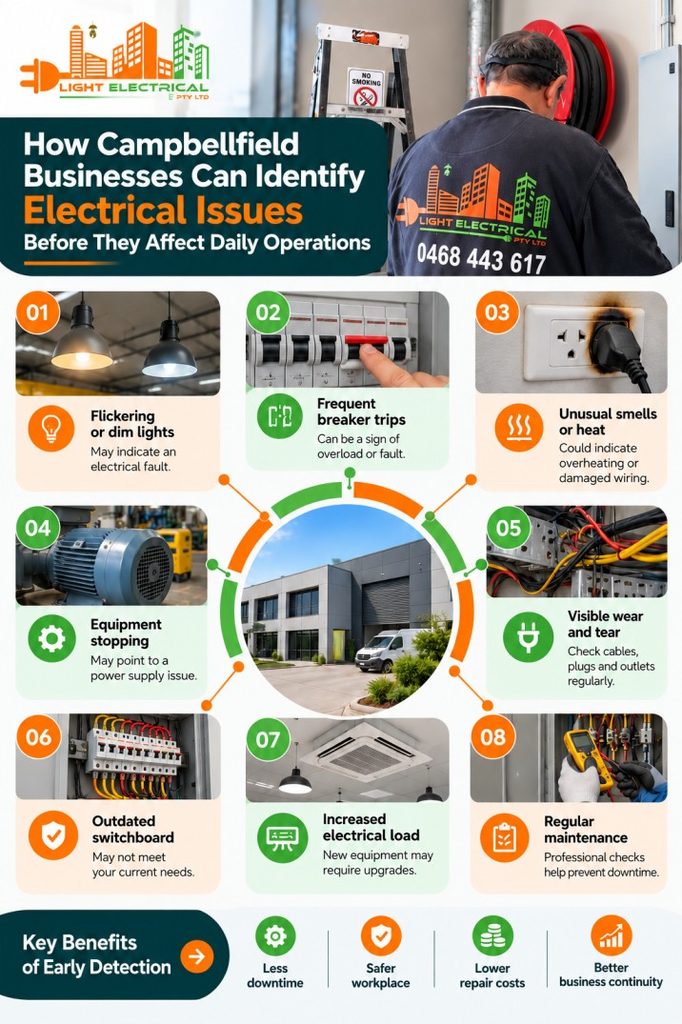
Electrical problems rarely begin with a complete power failure. More often, the first warning signs are easy to overlook: lights that flicker during busy hours, circuit breakers that trip repeatedly, power outlets that feel unusually warm, or machinery that stops working without an obvious reason. For a business, these small problems can quickly become expensive interruptions.
Working with a qualified commercial electrician Campbellfield businesses can rely on helps identify potential electrical faults before they disrupt daily operations. Early inspections and timely repairs can reduce unexpected downtime, improve workplace safety and help businesses protect valuable equipment.
Campbellfield has a mix of warehouses, workshops, manufacturing facilities, retail premises and commercial offices. Each environment has different electrical demands. A warehouse may depend on lighting, forklift charging stations and automated equipment, while a workshop may use machinery that places heavy loads on electrical circuits. An office may experience problems with power distribution, computer equipment or communication systems.
Understanding these risks is an important part of running a reliable workplace. This is where Commercial Electrical Maintenance Campbellfield becomes relevant. Rather than waiting for equipment to fail, businesses can monitor warning signs, arrange appropriate inspections and address developing faults before they affect staff, customers or production schedules.
This guide explains what to look for, which problems deserve immediate attention, and how to establish a practical electrical maintenance routine.
Why Early Electrical Problem Detection Matters for Campbellfield Businesses
Electrical faults affect more than the equipment directly involved. A failed circuit can interrupt several workstations, delay deliveries, stop production and create safety concerns for employees.
Consider a small manufacturing workshop where a circuit breaker trips whenever multiple machines operate together. Staff might reset the breaker and continue working, assuming the issue is minor. However, the repeated tripping could indicate an overloaded circuit, a faulty appliance or another electrical problem that requires investigation.
Ignoring the warning may lead to longer interruptions and additional repair costs.
Early detection helps businesses:
Reduce downtime: Identify developing faults before they interrupt essential operations.
Protect equipment: Investigate unusual electrical behaviour before it damages connected machinery or electronics.
Improve workplace safety: Address damaged wiring, overheating components and other potential hazards.
Plan maintenance costs: Schedule suitable repairs instead of relying entirely on emergency callouts.
Support business continuity: Reduce the likelihood of unexpected disruptions during important operating hours.
No maintenance plan can prevent every electrical failure. However, a consistent approach can help identify many developing problems while they are easier to investigate and manage.
What Are the Early Warning Signs of Commercial Electrical Issues in Campbellfield?
Identifying electrical problems early starts with recognising changes in how a workplace’s electrical systems behave. Staff members often notice these changes before a fault becomes obvious, so businesses should encourage employees to report unusual sounds, smells, heat or interruptions.
1. Why Do Lights Flicker or Dim During Working Hours?
Flickering lights are easy to dismiss, particularly when they happen occasionally. However, repeated flickering or sudden dimming can indicate a loose connection, a problem with a lighting circuit, an overloaded supply or an issue with connected equipment.
For example, a warehouse manager might notice that overhead lights dim whenever a large machine starts. If the pattern repeats, it is worth recording when it occurs and asking a qualified electrician to investigate.
What businesses should do:
Record which lights are affected and when the problem occurs.
Check whether the issue affects one area or the entire premises.
Report recurring flickering rather than repeatedly switching lights on and off.
Arrange a professional assessment if the problem continues.
Do not remove light fittings or open electrical panels to investigate the cause yourself.
2. What Does Repeated Circuit Breaker Tripping Mean?
Circuit breakers are designed to interrupt power when certain electrical conditions become unsafe. Repeated tripping may indicate an overloaded circuit, a faulty appliance, damaged wiring or another fault that needs attention.
A common workplace scenario involves adding new equipment without reviewing the existing circuit capacity. A workshop that originally used two machines might later add another high-demand appliance to the same circuit. The breaker may then trip when the equipment operates together.
The correct response is to identify the underlying cause, not to keep resetting the breaker.
If a breaker trips repeatedly, stop using the affected equipment and arrange an electrical assessment. Never bypass a protective device or replace it with a higher-rated breaker without a proper assessment.
3. How Can Unusual Smells, Heat or Sounds Reveal Electrical Faults?
Electrical components should not produce persistent burning smells, crackling sounds or unexplained heat during normal operation.
Warning signs include:
A burning-plastic smell near a power outlet or switchboard.
Buzzing or crackling from electrical fittings.
Discoloured outlets or visible scorch marks.
Plugs or sockets that become unusually hot.
Smoke, sparks or signs of melting.
These symptoms may indicate overheating, poor connections, damaged components or arcing. They can present a serious fire or electric-shock risk.
If you notice smoke, sparks or a burning smell, treat the situation as urgent. Keep people away from the affected area, avoid touching the equipment and call emergency services if there is a fire or immediate danger. Arrange qualified electrical assistance before using the affected installation again.
WorkSafe Victoria identifies damaged equipment, exposed live parts and unsuitable electrical equipment as workplace hazards that require appropriate risk controls. WorkSafe Victoria’s electrical safety guidance provides further information.
4. Why Are Some Machines or Appliances Stopping Unexpectedly?
Unexplained shutdowns, intermittent operation and unusual equipment behaviour can have several causes. The fault may be within the machine itself, its control system, its electrical connection or the supply feeding it.
For example, a commercial refrigerator that repeatedly loses power may put stock at risk. In a manufacturing facility, an intermittent supply to a machine could delay an entire production run.
When this happens, record the equipment involved, the time of the interruption and any warning messages. Check whether other equipment experiences similar symptoms, but do not repeatedly restart a machine if doing so could worsen the fault or create a hazard.
A qualified electrician can assess the electrical supply and installation, while an appropriate equipment technician can investigate faults within the machine itself.
How Can a Commercial Electrician Identify Hidden Electrical Problems?
A visual check can reveal damaged cables, broken fittings and other obvious defects. However, not every electrical fault is visible from the outside.
A professional assessment may include inspecting the switchboard, reviewing circuit protection, checking connections where safe and appropriate, and carrying out suitable electrical tests. The exact scope depends on the installation, the symptoms reported and the risks identified.
What Should a Commercial Electrical Inspection Cover?
The inspection should be based on the premises, equipment and working environment rather than a generic checklist alone.
Inspection area
What to look for
Switchboards
Signs of overheating, damage, unsuitable circuit protection or unclear circuit identification
Power outlets
Cracks, loose fittings, discolouration and signs of overheating
Cables and leads
Cuts, fraying, crushed insulation and damaged plugs
Lighting
Repeated flickering, failed fittings and inconsistent operation
Machinery connections
Intermittent power, damaged connections and recurring electrical faults
Safety devices
Appropriate operation and testing of RCDs and other protective devices
Electrical records
Previous faults, completed repairs, inspection findings and outstanding actions
This table is a starting point for reporting concerns, not a substitute for professional inspection or electrical testing.
The frequency and scope of inspection should reflect the workplace risk, the equipment in use, environmental conditions, applicable requirements and the manufacturer’s recommendations.
When Should Businesses Arrange Professional Testing?
Professional testing is particularly important when warning signs recur, equipment is exposed to harsh conditions, a workplace has undergone electrical changes, or previous inspections have identified unresolved concerns.
For certain workplaces and equipment, inspection, testing and tagging requirements apply under relevant Australian guidance and standards. WorkSafe Victoria explains that testing frequency depends on the equipment, its environment and how it is used. A test tag also does not guarantee that equipment remains safe after it has been damaged.
Businesses should ask their electrician which inspections and tests are appropriate for their particular premises and which records should be retained.
Commercial Electrician: How Can Businesses Reduce Electrical Risks?
A proactive approach combines employee awareness, routine visual checks, professional maintenance and clear reporting procedures. It does not require employees to diagnose electrical faults themselves.
Establish a Simple Electrical Reporting Process
Every employee should know how to report a damaged cable, recurring power interruption or unusual electrical smell. A simple process can prevent warning signs from being overlooked.
Ask staff to record:
The location of the issue.
The equipment or fitting involved.
The time and conditions when it occurred.
Any visible damage, smell, noise or interruption.
Whether the equipment has been taken out of service.
The person receiving the report should assess the urgency and arrange suitable action. Faulty equipment should be removed from service and isolated from use where appropriate, following workplace safety procedures.
Keep Switchboards and Electrical Access Areas Clear
Switchboards and electrical isolation points must remain accessible. Storage boxes, stock, cleaning supplies or machinery should not obstruct access.
Clear access helps authorised personnel respond efficiently when a circuit needs to be isolated or an electrical fault requires investigation. It also reduces avoidable delays during maintenance.
Employees should not open switchboards or attempt repairs. Electrical installation work must be performed by appropriately qualified and licensed professionals.
Review Electrical Capacity Before Adding Equipment
Business growth can change a property’s electrical demands. Adding machinery, refrigeration units, computer equipment, charging stations or air-conditioning systems may place additional loads on existing circuits.
Before installing new equipment, ask an electrician to assess whether the existing installation is suitable. Depending on the circumstances, the work may involve reviewing circuit capacity, protective devices, distribution arrangements and the available electrical supply.
This step is particularly useful for businesses expanding a warehouse, adding a production line or changing the use of an existing commercial space.
Electrical Repairs: When Should Campbellfield Businesses Act Immediately?
Not every electrical problem requires the same response. A failed light in a non-essential area may allow planned repair, while smoke, exposed wiring or signs of overheating can require immediate action.
The important distinction is between a minor operational inconvenience and a potential safety hazard.
Which Electrical Problems Need Urgent Attention?
Contact an appropriately licensed electrician urgently when you notice:
Repeated breaker trips or unexplained power loss.
Burning smells or signs of overheating.
Damaged electrical fittings or exposed conductors.
Persistent buzzing or crackling from electrical equipment.
Machinery that repeatedly loses power for an unexplained reason.
For smoke, fire, electric shock or an immediate threat to life, contact emergency services as appropriate and keep people away from the affected area.
A qualified emergency electrician Campbellfield businesses engage should investigate the underlying fault and determine what is required to make the installation safe. Restoring power alone is not sufficient if the original cause remains unresolved.
What Should You Do Before an Electrician Arrives?
The priority is to protect people and prevent further use of potentially faulty equipment.
Stop using the affected equipment.
Keep employees and visitors away from the hazard.
Follow your workplace emergency and isolation procedures, but do not approach unsafe equipment to isolate it.
Record the symptoms and any relevant operating conditions from a safe location.
Inform the electrician about previous faults, recent equipment changes and any unusual smells or sounds.
Never touch exposed wiring, attempt to repair a damaged outlet or repeatedly reset a breaker that continues to trip.
Electrical Maintenance: How Can a Preventive Plan Protect Daily Operations?
Electrical maintenance is most effective when it follows the actual risks and demands of a business. A warehouse with dust, vibration and heavy equipment may need different controls from a quiet office with computers and standard office appliances.
A useful maintenance plan identifies equipment, records known faults, sets inspection and testing schedules, and assigns responsibility for outstanding actions.
What Should a Commercial Electrical Maintenance Schedule Include?
The following framework can help a business organise its maintenance activities. It should be adapted to the site’s risk assessment, equipment requirements and applicable standards.
Daily or before-use checks
Look for damaged power leads, broken plugs, visible cable damage and other obvious defects. Workers should report faults and avoid using damaged equipment.
Scheduled workplace reviews
Review reported faults, repeated interruptions, equipment changes and outstanding repair recommendations. Check that electrical access areas remain clear.
Planned professional maintenance
Arrange inspections, electrical testing and repairs at intervals appropriate to the installation, equipment, risk level and regulatory requirements.
After repairs or operational changes
Record completed work, retain relevant documentation and review whether new machinery, renovations or changes in operating conditions require additional checks.
A maintenance schedule should never be treated as permission to ignore a fault until the next inspection. New hazards require prompt assessment.
How Can Businesses Use Maintenance Records to Spot Recurring Faults?
Maintenance records can reveal patterns that are difficult to recognise when each incident is treated separately.
Suppose a distribution warehouse records three power interruptions affecting the same work area over six weeks. Individually, each event may seem minor. Together, they indicate a recurring problem that deserves investigation.
Useful records include:
The date and location of each fault.
The affected equipment or circuit.
The symptoms reported by employees.
The electrician’s findings and recommended corrective actions.
The date repairs were completed.
Any follow-up testing or further action required.
These records help management prioritise recurring issues and make informed decisions about maintenance budgets.
For businesses seeking structured Commercial Electrical Maintenance Campbellfield, the practical goal is to create a documented process that connects reported symptoms with professional investigation and completed corrective work.
Midway through this process, a business may choose to discuss its maintenance requirements with Light Electrical or another appropriately licensed electrical contractor. The important consideration is to select a contractor whose qualifications, scope of work and proposed inspection process match the site’s requirements.
Electrical Services: What Should Businesses Check When Their Operations Change?
Electrical systems that were suitable several years ago may no longer meet a business’s current needs. Changes in equipment, occupancy and working practices can introduce new demands or expose weaknesses in an existing installation.
Are New Machines Increasing Electrical Demand?
Before introducing high-demand equipment, businesses should confirm that the existing electrical installation can safely support it.
For example, adding several commercial refrigeration units may increase the continuous load on a circuit. Installing additional machinery may also affect starting currents and the way loads are distributed.
An electrician can assess the proposed equipment and determine whether circuit alterations, additional protection or other changes are necessary. Do not assume that an available power outlet automatically means the circuit has sufficient capacity.
Could Dust, Moisture or Vibration Be Affecting Electrical Equipment?
Manufacturing areas, workshops and warehouses can expose electrical equipment to conditions that accelerate wear or damage.
Potential risks include:
Dust entering equipment that is not suitable for the environment.
Moisture affecting fittings or connections.
Vibration contributing to mechanical wear or connection problems.
Cables being crushed by equipment or damaged by vehicle movement.
Leads crossing walkways or being exposed to sharp edges.
The solution is not simply to inspect more frequently in every situation. Businesses should identify the specific environmental risks and use suitable equipment, protective measures and inspection intervals.
What Should Businesses Review After Renovations or Fit-Outs?
Renovations, new partitions, additional workstations and changes to machinery layouts can alter how electrical systems are used.
Before returning an altered area to normal operation, confirm that the relevant electrical work has been completed and tested as required, that affected circuits are appropriately identified, and that any required documentation has been provided.
In Victoria, prescribed electrical installation work has specific inspection and certification requirements. Energy Safe Victoria explains the relevant obligations for electrical contractors and prescribed work in its registered electrical contractor guidance.
What Common Mistakes Cause Commercial Electrical Problems to Go Unnoticed?
Even businesses that take safety seriously can overlook developing faults when daily production pressures take priority.
Mistake 1: Repeatedly Resetting a Circuit Breaker
Resetting a breaker without investigating repeated trips can leave an underlying problem unresolved. Record the symptoms, stop using affected equipment when necessary and arrange a professional assessment.
Mistake 2: Assuming a Test Tag Guarantees Safety
A test tag records a test at a particular time. Equipment can be damaged afterwards, so workers must still check for visible defects before use and report new concerns. WorkSafe Victoria specifically advises that damaged equipment must not remain in use simply because it has a test tag.
Mistake 3: Using Extension Leads as a Permanent Solution
Extension leads may be useful for suitable temporary applications, but relying on them indefinitely can introduce trip hazards, cable damage and unsuitable loading.
Where additional power is regularly required, ask an electrician to assess whether fixed outlets or other suitable electrical changes are needed.
Mistake 4: Delaying Repairs Because Equipment Still Works
An outlet with scorch marks or a machine with an intermittent electrical fault may continue operating temporarily. Continued operation does not establish that the equipment is safe.
Stop using equipment when it presents a potential hazard and arrange appropriate investigation.
Mistake 5: Treating Maintenance as a Once-a-Year Task
An annual visit alone may not address every risk. The correct schedule depends on the workplace, equipment, environmental conditions and applicable requirements. Staff reporting and ongoing visual checks remain important between professional inspections.
What Expert Advice Helps Prevent Electrical Downtime?
The most useful maintenance strategies are straightforward enough for staff to follow and specific enough to guide action.
First, identify critical equipment. List the machinery, refrigeration systems, communications equipment and other assets whose failure would seriously affect operations. This helps management prioritise risk assessments and recovery planning.
Second, investigate repeated symptoms. If the same circuit or machine experiences recurring problems, provide the electrician with a record of previous incidents rather than treating each event in isolation.
Third, coordinate maintenance with business operations. Where practical and safe, plan non-urgent work around production schedules or quieter trading periods. Safety-critical repairs should never be postponed simply to avoid disruption.
Fourth, verify corrective actions. Ask what caused the fault, what work was completed, whether testing was required and whether any further recommendations remain outstanding.
Finally, make reporting easy. Staff are more likely to report a problem when they know whom to contact and what information to provide.
A licensed electrician Campbellfield VIC businesses appoint should be appropriately licensed for the work, explain the findings clearly and identify any necessary follow-up actions. For electrical installation work, businesses should also verify that the contractor has the appropriate registration and that relevant certification and inspection requirements are met.
These practices help make electrical safety part of normal business management rather than a response reserved for major failures.
Conclusion
Electrical faults often provide warning signs before they cause significant operational disruption. Flickering lights, repeated circuit breaker trips, unusual smells, damaged cables and unexplained machinery shutdowns should be investigated rather than dismissed as minor inconveniences.
For Campbellfield businesses, a practical approach combines employee reporting, routine visual checks, risk-based professional inspections and accurate maintenance records. Reviewing electrical capacity before adding equipment and responding promptly to recurring faults can also help protect staff, machinery and daily operations.
Working with a qualified commercial electrician Campbellfield businesses can trust helps ensure electrical concerns are assessed appropriately and repairs are completed by competent professionals. Light Electrical can be considered when exploring electrical support for your commercial premises. Choose a contractor whose qualifications, experience and proposed maintenance plan suit your business’s specific needs.
Frequently Asked Questions About Commercial Electrical Problems
1. What are the most common electrical problems in Campbellfield commercial buildings?
Common problems include overloaded circuits, damaged cables, faulty outlets, repeated circuit breaker trips, flickering lights and equipment that loses power unexpectedly. The exact risks depend on the premises. Warehouses and workshops may face additional concerns from dust, vibration, moving equipment and heavy electrical loads. Businesses should document recurring symptoms and arrange a qualified assessment rather than assume the cause is obvious.
2. How often should a business arrange commercial electrical maintenance?
There is no single maintenance interval suitable for every commercial property. The schedule depends on the type of installation, equipment, environmental conditions, usage and applicable standards. Some equipment requires regular visual inspections and testing, while particular electrical installations may need more specialised assessments. Businesses should establish a risk-based maintenance plan with a qualified electrician and review it whenever equipment, operating conditions or workplace layouts change.
3. When should a business call an emergency electrician in Campbellfield?
Contact an electrician urgently for recurring power failures, repeated circuit breaker trips, suspected electrical faults or damaged electrical fittings. Smoke, sparks, burning smells and exposed wiring require immediate safety precautions, and a fire, electric shock or immediate threat to life may require emergency services. Keep people away from the affected area and do not attempt repairs. An electrician should investigate the underlying cause before the affected equipment or installation is returned to service.
4. Can regular electrical maintenance reduce business operating costs?
Preventive maintenance can reduce avoidable downtime, help identify deteriorating equipment and make repair costs more predictable. For example, investigating recurring power interruptions may help prevent repeated production delays. However, maintenance cannot eliminate every failure, and savings are not guaranteed. Businesses should assess the cost of planned inspections against the potential consequences of equipment failure, including lost operating time, damaged stock and interrupted customer service.
5. How can a business choose a reliable commercial electrician in Campbellfield?
Look for an appropriately licensed electrician with experience relevant to your premises and the type of electrical work required. Confirm the contractor’s registration where applicable, request a clear scope of work, and ask how findings, test results and recommended repairs will be documented. For larger commercial installations, clarify how work will be coordinated with operating schedules and safety procedures. Businesses should also confirm any required certificates and inspections before affected electrical installations are put into service.
At Light Electricians Pty Ltd., we care about our clients and helping them get peace of mind knowing that your electricians system is working properly. Our technicians are licensed, trained, and skilled to handle any electricians project, no matter how big or small. Our electricians design, install, service, and repair electricians systems and parts in strict accordance with the highest industry standards. Our team knows you’re busy, and your time is valuable.
Contact Light Electricians Pty Ltd. today to get a competitive quote for the best brand of safety switches and switchboard upgrades, whether you want to do a major upgrade or need to replace all your circuit breakers with safety switches. We are committed to absolute professionalism and take great pride in our customers' satisfaction. Don't wait to get your switchboard upgraded contact us today.