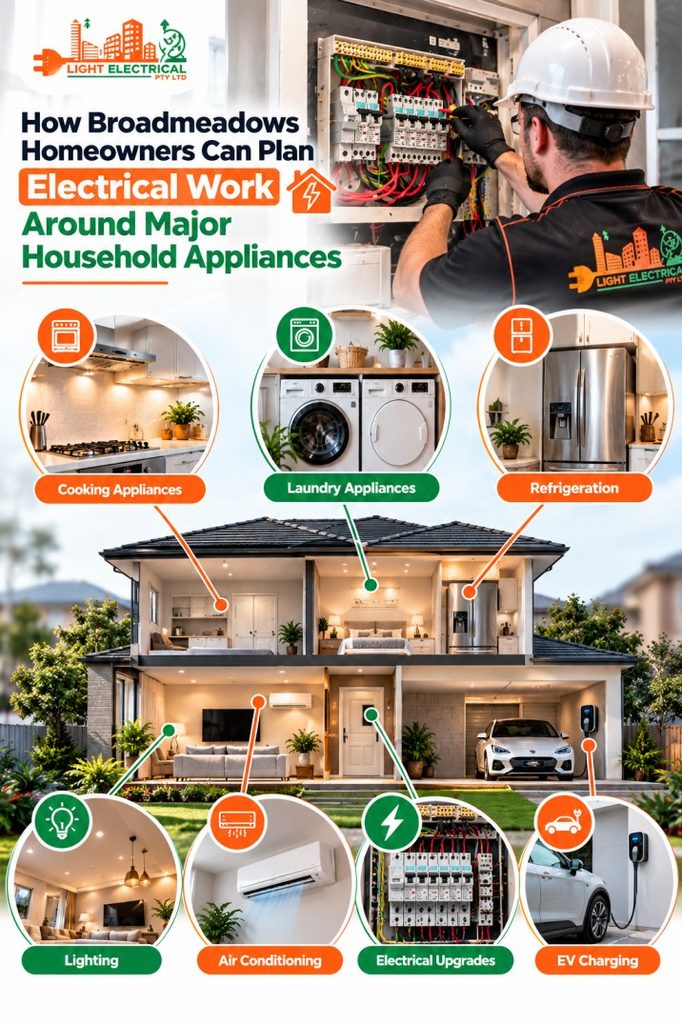
Modern household appliances make everyday life easier, but they also place significant demands on a home’s electrical system. Refrigerators run continuously, washing machines draw power during their cycles, electric ovens need substantial electrical capacity, and air conditioners can increase electricity demand during Melbourne’s warmer months. When several appliances operate simultaneously, an electrical system that has not been assessed for current household needs may experience overloaded circuits, tripping safety switches or other avoidable problems.
For homeowners, planning electrical work before purchasing, replacing or relocating major appliances can prevent unnecessary disruption and help maintain a safer home. A residential electrician Broadmeadows homeowners consult should understand how appliance requirements, circuit capacity, wiring condition and the layout of the property affect installation decisions.
Whether you are renovating a kitchen, upgrading an older switchboard or installing a new split-system air conditioner, the right preparation makes a difference. You need to know which appliances require dedicated circuits, where additional power outlets may be appropriate, and when an electrical inspection should happen before installation day.
This guide explains how to coordinate appliance purchases with electrical work, recognise potential warning signs, and make informed decisions about Residential Electrical Safety and Maintenance in Broadmeadows. It also covers practical examples, common planning mistakes, and questions worth asking an electrician before work begins.
Why Major Appliances Should Influence Your Electrical Plan
A household electrical system must safely accommodate the appliances connected to it, not simply the number of rooms in the property. Two homes with similar floor plans can have very different electrical requirements because of their cooking equipment, heating systems, laundry appliances and charging needs.
For example, a home with a gas cooktop, a standard refrigerator and a basic washing machine may have different electrical demands from a renovated property with an induction cooktop, electric oven, heat-pump dryer and ducted air conditioning.
The important consideration is how much power each appliance requires and how that demand interacts with the existing electrical installation.
Before arranging new Electrical Work for Broadmeadows Homes, homeowners should consider:
- The appliance’s rated power and manufacturer installation requirements.
- Whether the appliance needs a dedicated circuit or a specific connection arrangement.
- The capacity and condition of the existing switchboard and wiring.
- The number and location of existing power outlets.
- Whether several high-demand appliances may operate simultaneously.
- Any planned renovations or future appliance purchases.
A qualified electrician can assess these factors and determine whether the existing installation is suitable or requires modifications.
1. Residential Electrician Planning for Kitchen Appliances
What should you check before installing a new oven, cooktop, or dishwasher?
The kitchen is often the most demanding area of a home from an electrical planning perspective. Refrigerators, microwaves, dishwashers, electric ovens, induction cooktops and small appliances may all operate within the same space.
A common planning mistake is choosing the appliances and completing the cabinetry before considering the electrical connections. This can leave outlets in awkward locations, create access problems or require additional work after the kitchen has been fitted.
Plan electrical requirements before ordering appliances
Before finalising your kitchen design, prepare a list of the appliances you intend to install. Record their dimensions, electrical ratings, connection requirements and proposed positions.
Pay particular attention to:
- Electric ovens: Check the manufacturer’s rated load and connection instructions. Some models require a dedicated circuit and fixed connection.
- Induction cooktops: Confirm the electrical supply requirements before selecting the model. Some units may require a higher-capacity circuit or a particular connection arrangement.
- Dishwashers: Plan an appropriate electrical connection that remains accessible for servicing and complies with the requirements for the installation location.
- Refrigerators: Allow sufficient ventilation and avoid placing the appliance where its power cord could be crushed or stretched.
- Microwaves and other benchtop appliances: Plan enough conveniently positioned outlets to avoid relying on multiple adaptors or extension leads.
The exact arrangement depends on the appliance specifications and the existing electrical installation. A licensed electrician can assess whether the available circuits and switchboard can support the proposed equipment.
Coordinate your electrician with the kitchen installer
Suppose a Broadmeadows homeowner is replacing an old electric oven with a new oven and induction cooktop. The cabinetry measurements have been finalised, but the electrical requirements have not been checked.
If the new appliances need different connections, the homeowner may face additional labour, delayed installation, or changes to the cabinetry schedule.
A better approach is to arrange an electrical assessment before the cabinetry and benchtop installation is complete. The electrician can identify connection requirements, discuss outlet positioning and coordinate the electrical work with other trades.
Practical tip: Keep the appliance manuals and specification sheets together. They give your electrician more reliable information than a product name or photograph alone.
2. Electrical Services for Laundry Appliances
How can you plan a safer and more practical laundry?
Laundry rooms can contain washing machines, clothes dryers, hot-water equipment and occasionally additional appliances such as freezers. These devices may operate for extended periods, and some have substantial electrical demands.
A washing machine and dryer running together may be perfectly appropriate on a suitably designed installation. However, homeowners should not assume that separate wall outlets automatically mean separate electrical circuits.
Check the washing machine and dryer requirements
Before installing new laundry appliances, check the following:
- The rated power and connection instructions for each machine.
- Whether the existing circuit is suitable for the combined load.
- Whether the power points are undamaged and correctly positioned.
- Whether electrical connections are protected from water exposure.
- Whether cords can be kept clear of moving parts, sharp edges and areas where water may collect.
If you are installing a heat-pump dryer or replacing several older appliances at once, ask the electrician to assess the proposed combination rather than checking each device in isolation.
Victoria’s Energy Safe guidance warns against damaged electrical equipment, unsafe adaptors and the use of electrical appliances near water.
Keep the laundry practical as well as safe
Electrical planning should account for how you will use the room. A power point hidden behind a heavy washing machine may be difficult to access, while an extension lead across a walkway can introduce a trip hazard.
Discuss appliance clearances, maintenance access and the location of water connections with your electrician and installer. Any relocation or installation of electrical outlets must be carried out by a suitably licensed electrical professional.
For homeowners arranging Electrical Work for Broadmeadows Homes, coordinating these details before the laundry is fitted can reduce the need for later modifications.
3. Electrical Upgrades Before Installing High-Demand Appliances
When is an existing electrical system no longer suitable for your plans?
Replacing one appliance does not automatically mean your home needs a switchboard upgrade. However, several new appliances, an older electrical installation or repeated circuit problems can justify a professional assessment.
Electrical capacity is determined by the installation as a whole. The condition of the wiring, circuit protection, supply arrangements and expected demand all matter.
Recognise when an assessment is worthwhile
Arrange an assessment before adding major appliances if you notice any of these circumstances:
- Circuit breakers or safety switches trip repeatedly.
- Lights flicker when certain appliances start.
- Power points become unusually warm or show discolouration.
- You hear buzzing or notice a burning smell near electrical equipment.
- The switchboard is old, or its safety arrangements are unclear.
- You are replacing several gas appliances with electric alternatives.
- You plan to add an EV charger, electric heating or another high-demand device.
These signs do not all indicate the same fault. For example, a safety switch can trip because of an earth leakage problem, whereas a circuit breaker may operate because of an overload or fault. A qualified electrician needs to determine the cause.
Energy Safe Victoria recommends checking older wiring and ensuring suitable safety switches are installed. It also warns that old or deteriorated wiring can be dangerous.
Understand what a switchboard upgrade can achieve
A switchboard upgrade may provide more suitable circuit protection, space for additional circuits or improved arrangements for a changing household electrical load. It cannot, by itself, guarantee that every appliance can be operated simultaneously; the electrician must also consider the supply capacity, wiring and circuit design.
Ask for an explanation of the existing limitations and the proposed changes before approving work. A useful assessment should distinguish between what is essential for safety, what is needed for the new appliances and what would simply be a convenient future improvement.
For major switchboard replacement work in Victoria, prescribed inspection and certification requirements may apply. Confirm with the electrical contractor which testing, inspection and Certificate of Electrical Safety arrangements are required for your specific job.
4. Local Electrician Advice for Planning Appliance Locations
Where should power points and connections be placed?
Appliance location affects convenience, access, ventilation and electrical safety. Planning these details early can help prevent cables from being trapped behind cabinetry or appliances from blocking access to connections.
A local electrician can assess the proposed layout and explain the practical limitations of your existing installation before renovation work begins.
Plan by room, not just by appliance
Consider each area of the house separately.
Kitchen: Coordinate connections with cupboards, benchtops, the oven, cooktop, refrigerator and dishwasher.
Laundry: Consider washing machine and dryer positions, water exposure, ventilation and maintenance access.
Living areas: Plan outlets for televisions, entertainment equipment, computers and other devices without creating a tangle of extension leads.
Bedrooms: Consider charging locations, home-office equipment, portable heaters and any planned air conditioning.
Garage: If you intend to install a workshop appliance, freezer or EV charger, have the electrician assess the additional demand and the suitability of the existing circuits.
Do not choose an outlet location solely because it is easy to install. It must also comply with applicable requirements, including clearances around cooking appliances and restrictions for wet areas.
Make future needs part of today’s plan
You might not need an EV charger or a second refrigerator today, but it is worth mentioning possible future additions during an electrical assessment.
Depending on the property, planning ahead may reduce later disruption by allowing appropriate circuit routes, switchboard space or other provisions to be considered during renovation work.
However, future-proofing should be based on realistic needs. Installing equipment you may never use can increase costs without providing meaningful value.
5. Residential Electrical Safety and Maintenance in Broadmeadows
What should homeowners maintain after the electrical work is complete?
Residential Electrical Safety and Maintenance in Broadmeadows should be an ongoing consideration, particularly when a home contains older wiring or several high-demand appliances.
New equipment does not remove the need to maintain existing electrical accessories and follow appliance manufacturers’ instructions.
Create a simple household maintenance routine
Homeowners can carry out basic visual checks without opening electrical equipment or attempting repairs.
- Inspect accessible appliance cords and plugs for visible damage.
- Stop using cracked, broken or discoloured power points and arrange professional attention.
- Keep dryer lint filters clean according to the manufacturer’s instructions.
- Keep appliances ventilated and free from accumulated dust where the manual recommends it.
- Avoid piggyback adaptors and connecting one power board to another.
- Keep electrical equipment and cords away from water.
- Follow the manufacturer’s instructions for cleaning and servicing appliances.
- Test safety switches according to their instructions and current official guidance.
Energy Safe Victoria recommends testing household safety switches every three months. Follow the instructions for the particular device, and contact a licensed electrician if a safety switch fails to operate correctly or will not reset.
Know the difference between a safety switch and a circuit breaker
These devices serve different purposes.
A safety switch, also called a residual current device (RCD), monitors electrical current and helps protect people by disconnecting power when it detects certain leakage conditions.
A circuit breaker protects a circuit against overcurrent, including overloads and short circuits.
Neither device makes unsafe wiring or damaged appliances harmless. Their effectiveness depends on the correct installation, condition and circuit coverage.
If you are uncertain which protection your home has, ask a licensed electrician to inspect the switchboard and explain its operation.
6. How to Schedule Electrical Work Around Your Household Routine
When should you book the electrician, appliance delivery and installation?
Good scheduling can reduce disruption, especially when a kitchen, laundry or heating system is being upgraded.
Electrical work may require temporary power interruptions. If your refrigerator contains perishable food, you work from home, or your household relies on electric hot water, discuss the timing with your contractor before work begins.
Follow a practical installation sequence
Step 1. Prepare an appliance list. Record which appliances will be installed, replaced, or relocated. Include their model numbers and manufacturer requirements where available.
Step 2. Arrange an electrical assessment. Ask a licensed electrician to assess the existing circuits, switchboard, wiring, and proposed appliance locations.
Step 3. Confirm the scope of work. Establish whether the project requires new outlets, dedicated circuits, wiring changes, or switchboard modifications.
Step 4. Coordinate other trades. Discuss the order of electrical work, cabinetry installation, plumbing, appliance delivery, and final connections.
Step 5. Complete required testing. The electrician should perform the applicable tests and checks before the affected installation is returned to service.
Step 6. Confirm documentation. Ask whether a Certificate of Electrical Safety is required and ensure you receive the relevant documentation.
This process is particularly helpful when several appliances are being replaced together. It also allows you to address electrical issues before they interfere with the rest of the renovation.
Example of a planned kitchen upgrade
Imagine a Broadmeadows household replacing its electric oven, adding an induction cooktop and purchasing a dishwasher.
Rather than arranging all three deliveries for the same morning, the homeowner first provides the appliance specifications to the electrician. The electrician assesses the existing installation and identifies the work required.
The homeowner then schedules any necessary electrical modifications before the final appliance installation. Once the relevant work and checks are complete, the appliances can be installed in the agreed sequence.
The benefit is not simply convenience. The approach reduces uncertainty about whether the existing electrical installation is suitable for the new equipment.
7. Common Mistakes to Avoid When Planning Electrical Work
Which decisions can lead to unnecessary costs or safety concerns?
Buying appliances before checking electrical requirements
A replacement appliance may have different electrical requirements from the model it replaces. Check the specifications before purchase, particularly for ovens, induction cooktops, dryers and heating equipment.
Assuming every power point has a separate circuit
Multiple outlets can share a circuit. The number of available sockets does not establish how much electrical load the circuit can safely support.
Ask your electrician to verify the circuit arrangement rather than relying on the outlet count.
Using extension leads as a permanent solution
Extension leads can create hazards when used improperly, especially with high-demand appliances, in wet areas or where cables can be damaged. Do not connect multiple power boards or use adaptors to compensate for an inadequate electrical layout.
Resetting a repeatedly tripping switch without investigating
A tripped protective device can indicate an overload, an appliance fault or an electrical problem. Repeatedly resetting it without addressing the cause can leave the underlying issue unresolved.
If it trips again, stop using the affected equipment and arrange professional investigation. Never force a switch to remain on.
Leaving electrical planning until after renovations
Installing additional outlets or circuits after cabinetry, plastering or flooring is complete may require extra work. Discuss electrical requirements before those surfaces are closed or finished.
Choosing a contractor based only on price
A low quote is not necessarily the most economical option if it excludes necessary testing, suitable circuit protection or documentation.
Compare quotations by looking at the scope of work, materials, testing, exclusions and any required certification. In Victoria, use an appropriately licensed electrical professional for electrical installation work.
8. When to Call an Emergency Electrician Broadmeadows
Which electrical warning signs require urgent attention?
Some electrical problems should not wait for a planned renovation or routine appointment.
Contact an emergency electrician in Broadmeadows promptly if you experience an electrical fault that creates an immediate safety concern, such as:
- Burning smells or smoke coming from a switchboard or power point.
- Sparks, arcing or visible damage to electrical equipment.
- Repeated protective-device trips accompanied by signs of overheating.
- An electric shock or tingling sensation from an appliance or metal fitting.
- Electrical equipment or wiring affected by flooding or water intrusion.
If there is smoke or fire, move everyone away from the danger and call emergency services on 000. Do not touch a damaged switchboard, exposed wiring or equipment affected by water. If you receive an electric shock or experience tingling from an appliance or tap, avoid further contact and seek urgent professional assistance.
Energy Safe Victoria advises homeowners not to attempt electrical repairs themselves and to engage a licensed electrician when a safety switch will not reset, or electrical equipment is damaged.
What to do while waiting for assistance
- Keep household members and pets away from the affected area.
- Stop using the suspect appliance if you can do so without approaching the hazard.
- Do not remove covers, open the switchboard, or attempt to repair wiring.
- Follow the electrician’s or emergency services’ instructions.
An electrical fault should be treated as a safety issue first, not simply an inconvenience caused by an appliance that will not operate.
9. Expert Tips for Better Electrical Planning
How can homeowners make more informed decisions?
The following practical measures can make an electrical project easier to plan and assess.
Keep a record of appliance specifications. Save the manuals, model numbers, and rated electrical requirements for major equipment. This helps the electrician assess the proposed load accurately.
Ask for a circuit assessment, not just an extra socket. If you regularly experience tripping or intend to install multiple high-demand appliances, the underlying circuit capacity may need attention.
Separate safety work from optional improvements. Ask which items are necessary to address an identified hazard, which are required for the new appliances, and which are optional convenience upgrades.
Accessibility plan. Connections should be positioned in accordance with applicable requirements while allowing safe servicing and avoiding trapped cords.
Discuss your typical household routine. If several appliances operate together every evening, explain that to the electrician. Expected simultaneous demand is more useful than considering each appliance independently.
Request clear documentation. Ask for the scope of work, test results where applicable, relevant certification and an explanation of any remaining limitations.
Avoid DIY electrical alterations. Homeowners can organise appliances, collect specifications and inspect accessible cords, but electrical installation and repairs must be undertaken by appropriately licensed professionals.
These steps support safer decisions and help homeowners understand what their electrical system can reasonably accommodate.
Conclusion
Planning electrical work around major household appliances is about more than adding power points. It involves understanding appliance requirements, checking existing circuits, considering simultaneous electrical demand, and coordinating installations with the rest of your household improvements.
For Broadmeadows homeowners, the best starting point is to prepare an appliance list, collect the relevant specifications, and arrange an assessment before purchasing or installing equipment that may significantly change the home’s electrical demand.
Prioritising Residential Electrical Safety and Maintenance in Broadmeadows also means responding promptly to warning signs, maintaining appliances properly and avoiding electrical repairs that require a licensed professional.
If you are planning a kitchen renovation, upgrading your laundry or introducing several new appliances, consult a qualified residential electrician Broadmeadows homeowners can rely on for an assessment of their specific installation. Understanding the requirements early can help you plan the work, manage costs, and keep your home safer.
Light Electrical provides reliable residential electrical services in Broadmeadows, including electrical repairs, lighting installation, switchboard upgrades, and home safety inspections. Our team focuses on safe, professional solutions for homeowners.
Frequently Asked Questions
1. Why should I hire a residential electrician in Broadmeadows before buying major appliances?
An electrician can assess whether your existing electrical installation is suitable for the appliances you intend to purchase. This is particularly useful when replacing gas cooking equipment with electric appliances, adding air conditioning or installing a high-demand dryer.
Before buying, share the manufacturer’s specifications with the electrician. They can identify potential requirements for additional circuits, suitable connections, switchboard modifications, or other electrical work. This helps you make an informed purchase and reduces the risk of discovering installation problems after delivery.
2. Does installing a new oven or induction cooktop always require a dedicated circuit?
No. The requirements depend on the appliance’s rated load, manufacturer instructions, connection method, and the existing electrical installation. Some appliances require a dedicated circuit, while others may be suitable for a different compliant arrangement.
A licensed electrician should assess the specific model and existing circuit rather than assuming that every oven or cooktop has identical requirements. Never use an unsuitable adaptor or modify wiring to make an appliance fit an existing connection.
3. How do I know if my Broadmeadows home needs an electrical upgrade?
Warning signs include repeated circuit trips, flickering lights, damaged outlets, unusual heat around electrical accessories or a switchboard with unclear or outdated protection. Homes with older wiring may also benefit from a professional inspection, particularly before adding several high-demand appliances.
These signs do not automatically mean a complete rewiring or switchboard replacement is necessary. A licensed electrician can investigate the cause, assess the installation and explain which improvements are required.
4. Can I run my washing machine, dryer and dishwasher at the same time?
Potentially, yes. Whether this is appropriate depends on the appliances’ electrical loads, the circuits they use, the switchboard and the home’s overall supply capacity.
Having three separate power points does not necessarily mean the appliances are connected to three separate circuits. If protective devices trip when appliances operate together, stop repeatedly resetting them and arrange an electrical assessment. Staggering appliance use may help manage demand, but it is not a substitute for correcting an unsuitable or faulty installation.
5. What should I check before hiring a licensed electrician in Broadmeadows, VIC?
Confirm that the contractor holds the appropriate Victorian electrical licence for the proposed work. Ask for a clear written quotation outlining the work, materials, testing, exclusions and any required inspection or certification.
Explain which appliances you plan to install and provide their specifications. Ask whether the existing circuits are suitable, whether additional work is necessary, and what documentation you will receive upon completion.
Choosing a contractor who explains the reasons behind their recommendations helps you make a better-informed decision about household electrical safety.